
Kerrville EIC agrees to spend $20 million to enhance quality-of-life projects
The only opposition came from EIC board member Gary Cochrane, who worried about the addition of the Heart of the Hills Heritage Center and the Guadalupe River Center.
The Kerrville Economic Improvement Corp. said yes to spending $20 million on a slew of quality-of-life projects on Monday night during one of the most consequential meetings for the group of 2023.
Interestingly, no one showed up to oppose the EIC’s effort to fund replacing the heating, air conditioning and roof at the Cailloux Theater, renovating the Olympic Pool and significant upgrades at Scott Schreiner Park. The only opposition came from EIC board member Gary Cochrane, who worried about the addition of the Heart of the Hills Heritage Center and the Guadalupe River Center.
Part of the confusion about the initiative is the term “bond,” which some believe impacts taxpayers, but that’s not necessarily the case. The reality is that EIC manages a portion of sales tax revenue that can pay for economic improvements, including quality-of-life projects.
Cochrane’s pushback came across several fronts, including his suggestion that the Heart of the Hills Heritage Center and the Guadalupe River Center were not essential. However, the Cailloux Theater, the pool and the golf course were all subjected to years of deferred maintenance.
The privately funded River Center’s inclusion wasn’t so much the issue but about the $2.2 million requested to develop Granger Macdonald Park, a 1-acre park in the floodplain on the south side of Lake Nimitz, which would also serve as a riverside frontage for the river center. It’s a park that the city’s Parks and Recreation Department didn’t want and can’t support currently.
The park was a gift from the Macdonald Companies to the city as part of the company’s apartment development “The Landing.” The proposed park would ostensibly serve the river center, with parking and river access.
Cochrane also questioned the optics of those who sat on EIC while sitting on the nonprofit boards of the river center and the history museum.
EIC members John Anderson, Gregg Appel and Celeste Hamman are all on the nonprofit board for the river center, while Joe Herring is on the Heart of the Hills Heritage Center.
Still, the projects faced significant support from the 13 people who spoke in favor of the bond. The EIC board unanimously approved spending nearly $15 million on the Cailloux Theater, the pool and the golf course. Cochrane voted against the Heart of the Hills Heritage Center and the improvements to the Granger Macdonald Park. Board Chair Kim Clarkson also voted against the river center, but her opposition focused on finding alternative funding.
The saga of the $20 million in funding will continue tonight when the City Council considers a resolution accepting the funding plan.
It took nearly two hours for the EIC to go through all of the motions to approve the financing and then to sit through the financials of the bonds, which sold simultaneously in the coming months.
After the approval of the bonds, the EIC tackled the potential move to bring a manufacturing facility to the area around the airport. The presentation about a Mexico-based company locating its U.S. headquarters to Kerrville clarified some confusion over the nature of the project, which the Kerr Economic Development Corp closely guarded.
The company, which goes by Litecrete, is easily confused with a Florida-based construction firm with the same name. However, Litecrete is a distributor and manufacturer of a German-developed lightweight concrete building material found in many Texas-based developments, including H-E-B stores.
KEDC Executive Director Gil Salinas said Kerrville is in competition with five other Texas cities and some in Oklahoma for a 150,000-square-foot plant and more than 60 permanent jobs — paying on average of $56,000.
To do it, the EIC had to approve giving 85 acres of EIC-owned land northwest of the Kerrville-Kerr County Airport. The EIC purchased the property to retain the U.S. Department of Agriculture’s research facility, which ultimately stayed on its historic campus north of Interstate 10.
Driving the plan, the company would spend more than $35 million to construct its building. The project also requires an interlocal agreement between the city and county to improve Al Mooney Road, connecting the project from Texas Highway 27, west of the airport.
Author

Related Articles
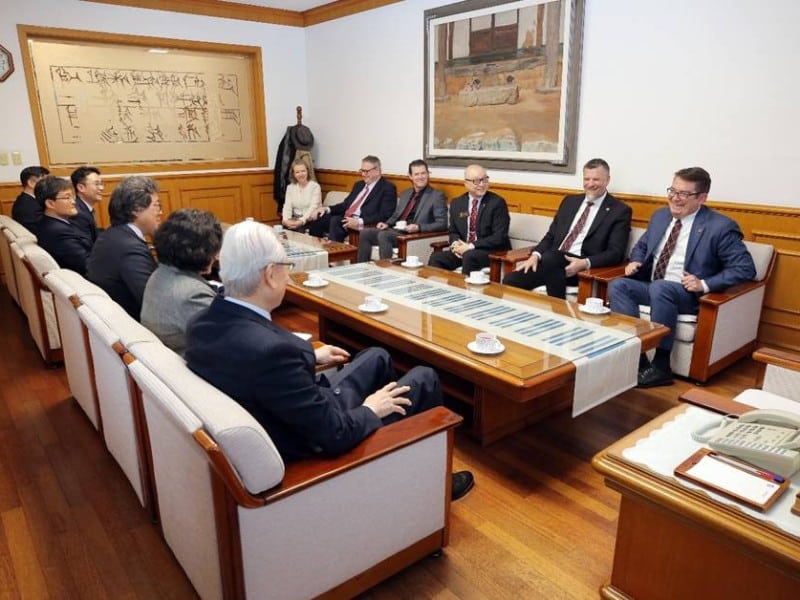
Schreiner University delegation signs four partnership agreements during South Korea visit
The March 16-24 visit produced five-year student exchange agreements with Soongsil University in Seoul, Keimyung University in Daegu and Seoul Women’s University, and renewed a cooperative agreement with Hannam University in Daejeon that dates to 2014.

Kerr County VSO, regional aging agency team up to expand support for veterans, older adults
The Kerr County VSO has joined with the Alamo Area Council of Governments Area Agency on Aging to connect eligible residents with support covering utility bills, durable medical equipment, nutritional supplements, vision and hearing care, basic dental services and minor home modifications such as grab bars, handrails and wheelchair ramps.

Kerr County gas prices tick up; Texas diesel within pennies of all-time record
Texas regular unleaded, by comparison, remains well below its own record of $4.695, set June 15, 2022 — though at $3.844 statewide, prices are up nearly a dollar from a year ago and rising fast. Premium in Texas now averages $4.697, just two cents below its own all-time high.
Comments (0)
There are no comments on this article.