
A primer on development in Texas, the builders hold most of the cards to build what they want … but
Most of the heat around a big housing project comes from a simple mismatch: people assume the city holds powers it doesn’t, and don’t use the power it does. The clearest way to see what’s real is to walk it from both sides.
The rules of Texas development, explained from the two chairs that matter: the builder who wants to put up the homes, and the neighbor who doesn’t want them there.
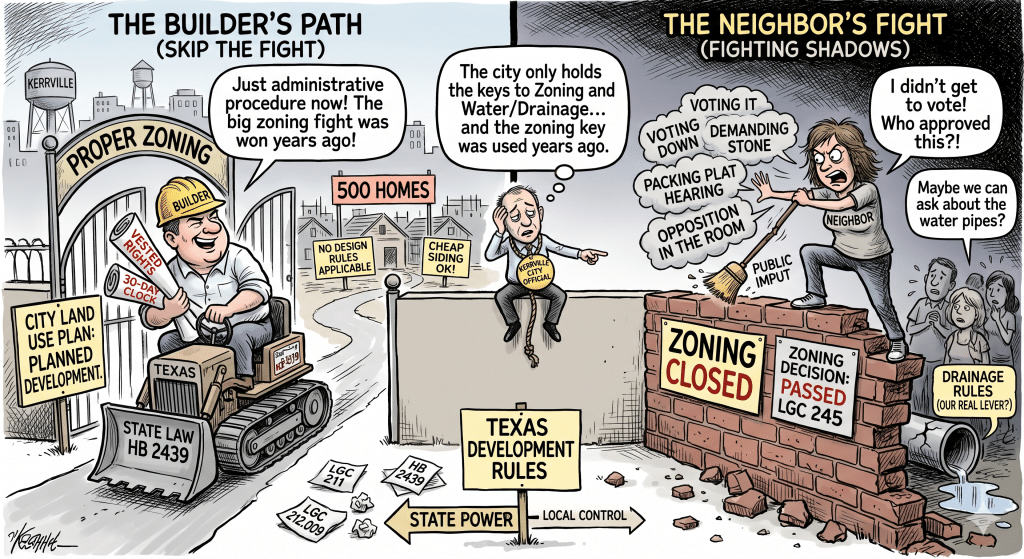
Most of the heat around a big housing project comes from a simple mismatch: people assume the city holds powers it doesn’t, and don’t use the power it does. The clearest way to see what’s real is to walk it from both sides.
You’re the builder. Here’s your path.
1. Start with land that’s already zoned for what you want to build. This is the only step where the city has real discretion — and the only step where the public gets a meaningful say. If the land carries a planned development designation under the city’s long-range plan, the hard part is mostly behind you. Picking land that’s already zoned right is how you skip the only fight you could lose.
2. Meet the subdivision ordinance and file your plat. From there it’s procedure, not politics. The city has 30 days to approve your plat, approve it with conditions, or turn it down. If it sits past the deadline, your plat is approved automatically. If it says no, it has to give you specific written reasons tied to an actual rule — “the neighbors hate it” isn’t one.
3. The rules lock in the day you apply. Whatever ordinances are on the books when you file your first permit are the rules for your project. The city can’t tighten them on you later to slow you down.
4. Build the infrastructure and prove the utilities. You put in the streets, water and sewer lines, and drainage. You have to show the city’s water and wastewater systems can actually serve your connections. You dedicate parkland or pay a fee instead.
5. Clear the floodplain and drainage rules. Inside the city limits, this is your real constraint — and the city can hold you to standards tougher than the federal minimum.
What you don’t have to do is just as important. You don’t have to use any particular materials or architecture — state law lets you build with anything the national code allows, and no one can force you to use stone instead of cheaper siding. You can’t be screened out over your company’s track record. And you never need a neighbor’s permission or a public vote.
You’re the neighbor. Here’s what you can — and can’t — do.
The blunt version first: if the land is already zoned for it and the plans meet the rules, you very likely can’t stop it. The decision that could have stopped it — the zoning — was probably made years ago.
What won’t work:
- Voting it down. There’s no ballot-box veto on individual projects in Texas. You don’t get to vote on a subdivision.
- Demanding nicer homes, better materials, or a different builder. The city has no power here. How a house looks and what it’s made of is controlled by private deed restrictions and HOA rules, not the city — so there’s no official to lobby for it.
- Packing the plat hearing. A plat that meets the ordinance has to be approved. Opposition in the room doesn’t change that, and the commission can’t legally act on it.
Where you actually have a voice:
- The zoning decision — if it’s still open. This is the one call where the city can say no and where public input genuinely counts. The problem is it comes early, often long before a project is news. If a rezoning or planned-development change is still pending, that’s the meeting to be at. If it already passed, that ship has sailed.
- Whether the project actually meets the rules. At the plat stage, your only real opening is the requirements themselves. The strongest, most legitimate questions are about adequate facilities — is there committed water and wastewater capacity to serve it? — and about floodplain and drainage. Framed as “does this meet the requirement,” not “we don’t want it,” those are things the commission can actually act on.
- Floodplain and drainage. This is your best substantive lever, because it’s the one area where local control is strong. And which flood data the city has formally adopted is a live choice — pushing the city to adopt newer, more conservative modeling is a real and legitimate ask.
- The long game. Who sits on the city council and the planning commission, and what the comprehensive plan says, is set by elections and plan updates. That’s where growth policy actually gets decided — not at any single project’s hearing.
The throughline
Texas has moved most of the levers people assume cities hold — over materials, design, builder quality, the pace of approval — to the state and to the developer. What’s left to a city like Kerrville is concentrated and specific: the zoning call, made early, and the water, sewer and drainage questions, settled by engineering review. The most useful thing anyone on either side can know is which of those decisions is still open, and where it actually gets made.
The laws doing the work here: building materials and design, HB 2439 (Government Code ch. 3000); the 30-day plat clock, Local Government Code §212.009; the rules-lock-in rule, Local Government Code ch. 245 (vested rights); municipal zoning authority, Local Government Code ch. 211.
Author

Related Articles

9-11 remembrances highlight another busy week of events across Kerr County
Friday brings three separate ways to mark the anniversary of the Sept. 11, 2001 attacks, alongside a midweek event tied to Kerrville’s own flood recovery.

Schreiner outlasts Austin College 33-27 in program’s first game since 1956
First-year coach Keith Allen didn’t sugarcoat his team’s first outing. Asked what went well, he said: “We scored more points than the opposing team.” Asked what didn’t: “Everything else. We’ve got to clean up a lot of stuff.”

Kerr County gas prices near record highs, far above last year’s rates
Statewide, regular gasoline is up from $2.77 a gallon a year ago — an increase of nearly 33%. Nationally, the trend looks similar. AAA’s national average stood at $4.14 a gallon this week, up from $3.19 a gallon a year ago, a jump of about 30%.
Comments (0)
There are no comments on this article.