
Board of Pardons, Parole says it has no record of Belew clemency, or request
The Texas Board of Pardons and Parole says it doesn’t have a record of Pct. 1 Commissioner Harley David Belew seeking a pardon.
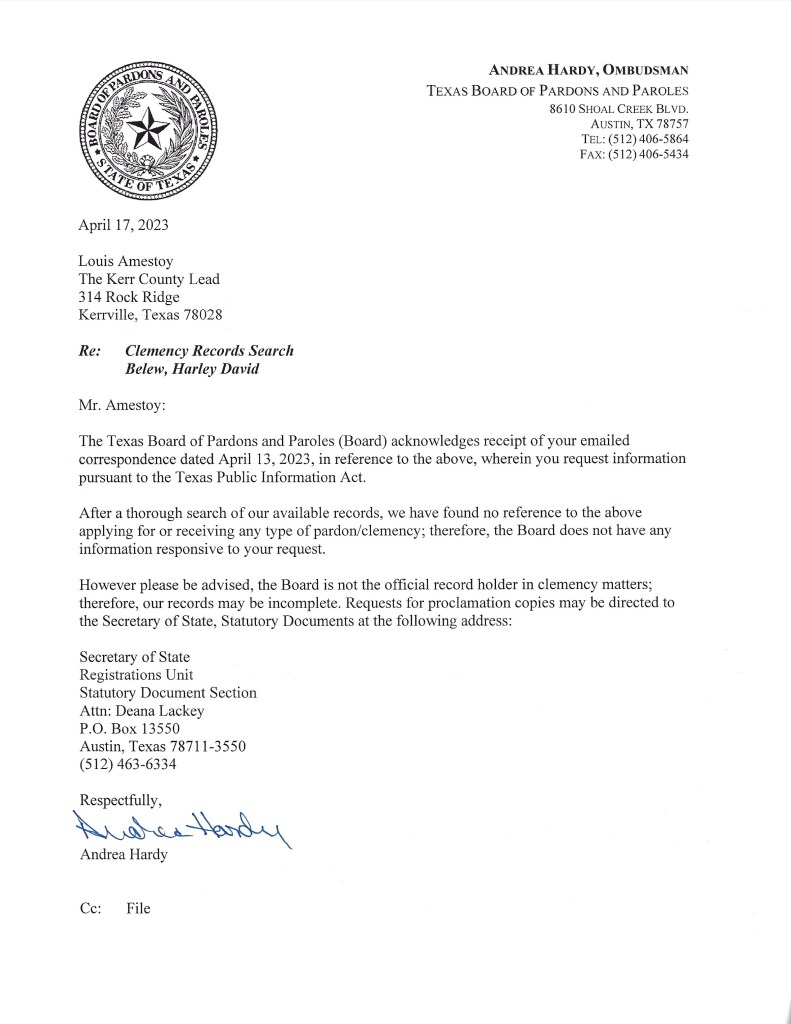
The Texas Board of Pardons and Paroles says it has no record of an application for pardon or clemency in the 1973 felony burglary case of Harley David Belew — the Kerr County Precinct 1 Commissioner.
Belew was convicted in 1973 of burglarizing at least two department stores and received a 10-year probation for the crime when he was 17. Belew’s criminal record remains on the Department of Public Safety’s criminal history database.
In a letter responding to The Lead’s public records request, Texas Board of Pardons and Paroles Ombudsman Andrea Hardy wrote that the board is not the official record holder in clemency matters; instead, that belongs to the Secretary of State’s office. In short, clemency matters issued by governors are there. Since the digitized clemency records only cover through the 1950s, The Lead filed a public records request to see if Texas governors or some other state agency had a pardon for Belew after 1983.
Even if there were a pardon, it would be in Belew’s best interests to remove that record from the state’s criminal database, but it does not appear he ever pursued that avenue.
The pardon or clemency issue is vital if Belew hopes to hold onto the commissioners’ court seat he’s held since 2016. In both the 2016 and 2020 elections, Belew signed statements that he had not been convicted of a final felony for which he had not received a pardon or had his full rights of citizenship restored by another official action.

“After a thorough search of our available records, we have found no reference to the above applying for or receiving any type of pardon/clemency; therefore, the Board does not have any information responsive to vour request,” Hardy wrote in her letter to The Lead.
In a wide-ranging investigation that now includes District Attorneys Stephen Harpold and Lucy Wilke, the most critical documents to Belew would be clemency or a pardon. However, Belew misled Republican officials and voters in 2016 and 2020 about his felony background.
In 2019, Texas Attorney General Ken Paxton wrote an opinion that elected officials could not serve with a felony conviction that had not received a pardon or some clemency. There was an assumption that felons with voting rights restored were eligible to hold public office, but Paxton said Texas case law does not support that argument.
Without proof of clemency, Belew is no longer qualified or eligible to serve on the Commissioners Court, according to Paxton’s 2019 opinion. With that opinion in place, Belew should not have been eligible to run for re-election.
Law enforcement and the district attorneys are investigating if Belew violated state law on his candidate applications, but the criminal statute of limitations has expired. Most of Texas’ voter fraud laws fixate on people conspiring to vote illegally, but there’s scant mention of candidates. In recent years, Texas has tamped down on what it considers voting schemes with heavy fines and felony charges.
The commissioners’ court is meeting Monday, and there is a closed-session item about consulting with County Attorney Heather Stebbins and how to proceed with Belew’s place on the court. Stebbins may have to recuse herself from proceedings involving Belew because she represents the court.
Author

Related Articles

502 Riverhill Blvd. wins 2025 KPUB Kerr County Christmas Light Tour, event ends after five years
The tour, sponsored by Kerrville Public Utility Board, featured video showcases of each finalist shared on The Kerr County Lead’s Facebook and YouTube channels, where community members voted for their favorites.

Holiday cheer, live music and community gatherings fill week ahead
The calendar features more than 50 events across seven days, ranging from support groups and wellness programs to holiday markets and live entertainment, offering something for nearly every interest and age group.

Texas wildlife officials warn of avian flu risk as migratory birds arrive
The virus poses particular risks to domestic cats, skunks, foxes, raccoons, bobcats, mountain lions and black bears, which typically contract the disease by consuming infected animal carcasses. Backyard poultry can also become infected through contact with wild birds.
Comments (0)
There are no comments on this article.