
Community Foundation launches regional flood fund, says housing and “muck and gut” work are greatest immediate needs
Foundation says new fund won’t touch remaining 2025 Kerr County donations; no grants issued yet as needs assessment gets underway
The Community Foundation of the Texas Hill Country is shifting its flood recovery strategy to a regional scale, its executive director said at a media briefing Friday, launching a new fund built to serve its entire multi-county service area rather than repeating last year’s Kerr County-only approach.
“The flooding is no longer isolated to one area,” Austin Dickson, the foundation’s executive director, said, adding that “communities across the entire Hill Country region have been impacted.”
Dickson said the new Texas Hill Country Flood Relief Fund is “a new regional fund created to support communities affected by the recent flooding we’ve seen across the community foundation’s 10 [county] service area.” He drew a direct contrast with the foundation’s response to the July 4, 2025 flood: “While last year’s fund that we created, the Kerr County flood relief fund, focused exclusively on Kerr County and Comfort, Texas,” the new fund “allows us to support all communities throughout the Texas Hill Country as recovery efforts unfold.” He identified the counties served as Bandera, Kerr, Kendall, Blanco, Gillespie, Kimble, Uvalde, Edwards and Real.
No co-mingling of funds
Dickson said donations still designated for last year’s Kerr County flood relief fund will not be mixed with the new regional fund. “Those dollars remain committed to the purposes for which they were donated,” he said. “The vast majority are planned for ongoing recovery efforts in Kerr County, and we will honor that original donor commitment.” He said the foundation’s priority is “maintaining donor intent and maintaining public trust.”
No grants yet; foundation gathering data first
Because the new fund launched only 24 hours before Friday’s briefing, no grants have been distributed yet. Dickson said fundraising totals are changing rapidly and it’s too early to compare them to last year’s campaign.
Rather than waiting for requests, “we are actively working with nonprofit organizations, local officials, and trusted community partners across the region to understand the most urgent needs,” Dickson said, adding that the foundation is “proactively making those calls and requests for information ourselves” to past grantees and case managers to build out a picture of the damage. Households affected by the flooding are encouraged to fill out a needs assessment form linked on the foundation’s social media channels.
Housing, “muck and gut” work top the list
“I suspect, like we’ve learned over the past year of flood recovery work, that the number one need is going to be housing needs, and I suspect that this disaster will be no different,” Dickson said. That includes “temporary housing assistance, relocation, home repair, home rebuilding … fixing a fence, fixing a driveway.”
He singled out “muck and gut” work — clearing wet, muddy debris out of flooded homes and businesses — as an urgent, often overlooked need. “It’s messy business,” Dickson said, “and urgent business,” because wet debris “creates mold and other damaging elements in structures and homes and businesses.”
In urban centers like Kerrville, Dickson said the foundation is also seeing “significant damage to civic infrastructure, pipes, roads, bridges, etc.” The foundation is partnering with organizations including LiftFund to assess business needs and is monitoring a business damage inventory being conducted by Kerr Together and Global Empowerment Mission.
“Not starting from scratch”
Dickson said the foundation is responding “from a position of experience and a position of preparedness” rather than starting over. “Nonprofit partners are in place,” he said. “They are ready.”
Addressing the possibility of donor fatigue so soon after 2025, Dickson said “the need this year is expansive… it’s across a much broader region” and “potentially is a more complicated undertaking in that there are more communities that are affected.”
He encouraged donations of any size, noting that “the vast majority of donations are small — $10, $25, $50 donations.” He added: “Fifty dollars can feed a family. It can support putting up a new fence or muck and gut a house.” Every dollar, he said, “counts in recovery.”
Dickson closed by reminding the public that “recovery doesn’t end when the floodwaters recede. It only begins.”
Donations to the Texas Hill Country Flood Relief Fund can be made at cftexashillcountry.fcsuite.com.
Author
Related Articles
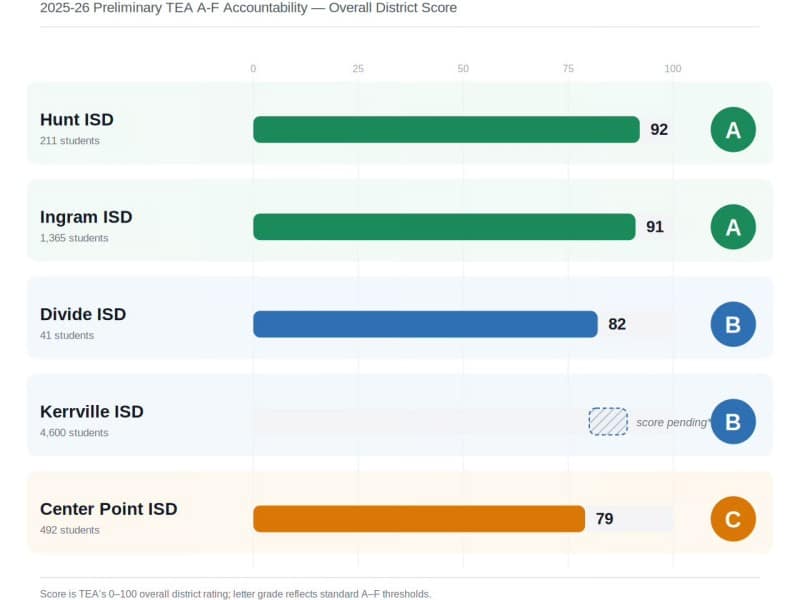
Ingram, Hunt lead the way in Kerr County statewide academic scores
Ingram and Hunt ISDs earned some of the strongest numbers in the county, Kerrville ISD showed signs of a rebound alongside a few slipping campuses, and Center Point ISD saw declines at two of its three campuses.
The top 25 moments from Lead Live’s Fifth Annual Nonprofit Week — so far
Sixty-eight segments. 121 guests. Six broadcast days, totaling more than 30 hours. What follows are the 25 moments from The Lead Live’s Fifth Annual Nonprofit Week that we can’t stop thinking about — the revelations, the stories, and the lines that captured something true about Kerr County in the summer of 2026.
Comments (0)
There are no comments on this article.