
How a geologist views the Kerr County flood of July 4
In Kerr County, Prince highlighted a limestone-dominated landscape with thin, clay-dominated soil. This soil is not effective at soaking up water, especially after drought conditions, causing rain to quickly sheet off the surface
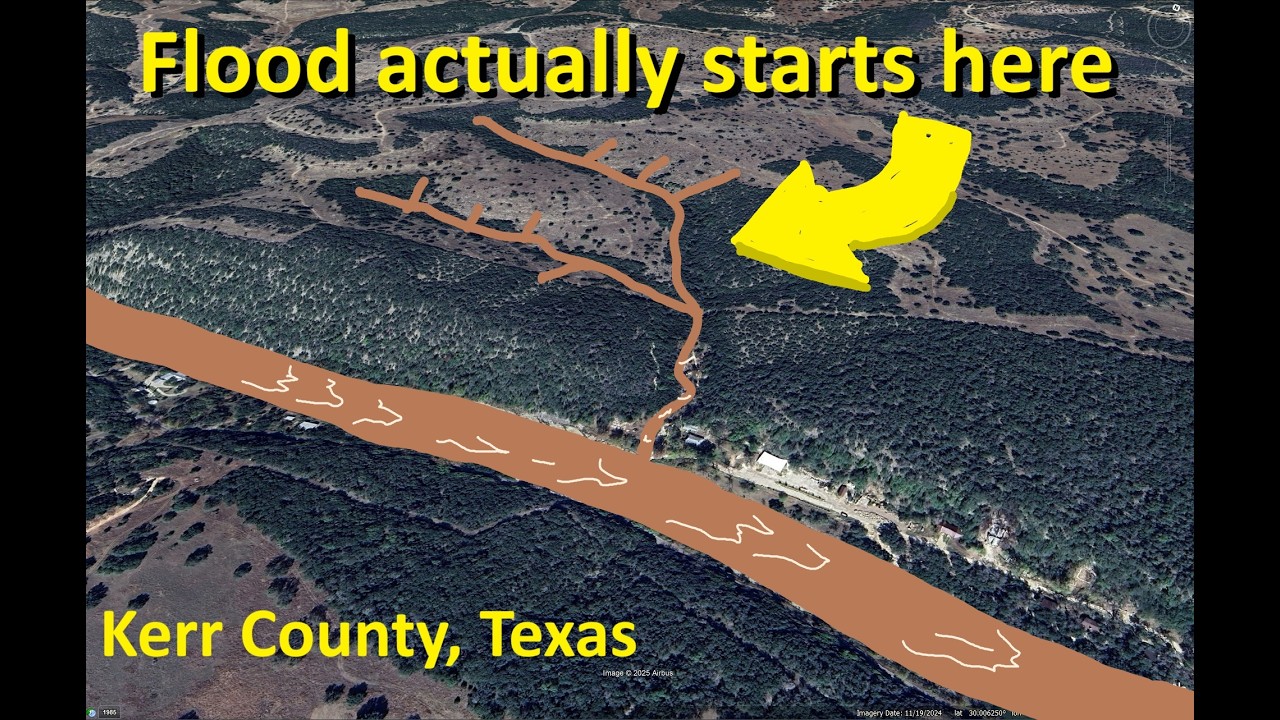
Virginia Tech geologist Philip Prince explained that while flooding occurs in rivers, its origins are on the landscape itself, specifically where rainfall initially hits the ground and makes its way downhill. He used Kerr County, Texas, and Buncombe County, North Carolina, as contrasting examples to illustrate how geology dictates a landscape’s flood response.
In Kerr County, Prince highlighted a limestone-dominated landscape with thin, clay-dominated soil. This soil is not effective at soaking up water, especially after drought conditions, causing rain to quickly sheet off the surface. This rapid runoff, combined with fairly steep but short slopes and a climate prone to intense rainfall events, leads to the development of a high drainage density—a vast number of small, closely spaced channels that are carved into the bedrock. These channels efficiently collect and funnel water into larger river systems like the South Fork of the Guadalupe River. The uniformity of this landscape over many miles means that an intense thunderstorm can produce an extreme effect over a large geographic area, funneling immense amounts of water into a single location.
In contrast, the landscape of Buncombe County, North Carolina, in the Appalachian Mountains, is geologically distinct. This area is heavily forested and features complex folded bedrock patterns and different mineral compositions compared to the flat-lying sedimentary rock of Kerr County. Instead of numerous bedrock channels, the Appalachian landscape is often covered in soil and large accumulations of sediment from past landslide events. While it also has a high drainage density, the branching patterns of its streams differ from those in the Texas Hill Country. The primary hazard in the Appalachians during heavy rainfall is debris flow-style landsliding, or mudslides, particularly when thick soils become saturated. The Appalachian landscape exhibits more geologic variety, with different rock types forming distinct landforms like mountains of varying sizes, leading to less uniformity in flood response over vast areas.
Prince concluded that the conditions that lead to floods like the one recently observed in Kerr County are very specific to that landscape. The Guadalupe River landscape has an almost unparalleled capacity on Earth to produce water runoff for a given surface area due to its unique geological characteristics. The recent Kerr County flood is considered the “event of record” in terms of intensity, meaning it has not been previously observed in recorded history. This extreme event was the result of a variety of characteristics converging, including the precise location of the most intense rainfall over the Guadalupe River system. Prince emphasized that geology is a fundamental factor in determining a landscape’s appearance and its behavior, particularly in relation to flood events. He explained that changing the underlying rock type, even by a relatively small amount, would drastically alter the river systems, soil, and overall flood behavior of the region.
Author

Related Articles

502 Riverhill Blvd. wins 2025 KPUB Kerr County Christmas Light Tour, event ends after five years
The tour, sponsored by Kerrville Public Utility Board, featured video showcases of each finalist shared on The Kerr County Lead’s Facebook and YouTube channels, where community members voted for their favorites.

Holiday cheer, live music and community gatherings fill week ahead
The calendar features more than 50 events across seven days, ranging from support groups and wellness programs to holiday markets and live entertainment, offering something for nearly every interest and age group.

Texas wildlife officials warn of avian flu risk as migratory birds arrive
The virus poses particular risks to domestic cats, skunks, foxes, raccoons, bobcats, mountain lions and black bears, which typically contract the disease by consuming infected animal carcasses. Backyard poultry can also become infected through contact with wild birds.
Comments (0)
There are no comments on this article.