
How one group of activists raised Kerrville’s taxes
By conflating and exaggerating Kerrville debt in 2021, a group of activists were the ones that helped sink the initial public safety building plan, forcing the taxpayers to pay more.
Defining the city’s debt is one of the most contentious issues for those running for the Kerrville City Council. While it’s true the city has $132 million in debt service, the reality of how the city pays it down and how it came to be is one where the facts are clear.
The narrative from We The People Liberty In Action says that Joe Herring Jr. and Brenda Hughes have a 100% record on approving tax increases. That’s one of the many blatantly false lies from this group, and we’re going to illustrate that the political action nonprofit, its members, and others had a hand in raising taxes.

In simplest terms, one group of activists, using false narratives, stopped the city from beginning the public safety complex when interest rates were at their lowest. The initial ask was $7 million to acquire land and develop a plan for designing and constructing the complex. What wasn’t fully known then is that the city’s initial study in 2019 aimed for a facility of about $22 million. However, the pandemic led to shelving those plans and new building codes that required a hardening of public safety facilities.
Opposing the initiative was the group “Let Us Vote,” an organization with three key spokespersons — Bethany Puccio, Robin Monroe and Nikki Cains. All three delivered impassioned reasons why they should be allowed to vote on city debt and supported Roman Garcia for City Council. Puccio is a director of We The People Liberty In Action. Cains’ associations and causes often parallel We The People Liberty In Action. Monroe mounted an unsuccessful City Council challenge against Brenda Hughes in 2022.

The City Council plan allowed the city to borrow at an interest rate of 2.8%, but the outrage at the spending plan came through a petition drive. However, much of the Let Us Vote crowd pushed a conflated narrative about the city’s spending priorities, lumping the various debt pools into one large sum. Puccio admitted as much during comments at the Aug. 24, 2021, City Council meeting, where she presented the petition to block the city using certificates of obligation.
“Past decisions to move forward with elective projects such as the sports complex, river trail extension, Arcadia and others instead of putting our money into necessities like our (police department) have caused frustration with many,” Puccio said. “Many expressed great frustration over the Sidney Baker Bridge project.”
In no uncertain terms, Puccio lumped all of the city’s projects and their funding into one bucket, calling it city debt, without providing the context about how the city pays for the projects mentioned.

At the same time, We The People Liberty In Action’s Terri Hall lurked around the conversation, amplifying the narrative that the city would widen pedestrian access on the Sidney Baker Bridge — something conceptualized and encouraged by the Texas Department of Transportation but never brought to fruition. During her Aug. 24, 2021, comments to the City Council, Hall took credit for We The People Liberty In Action helping boost the petition.
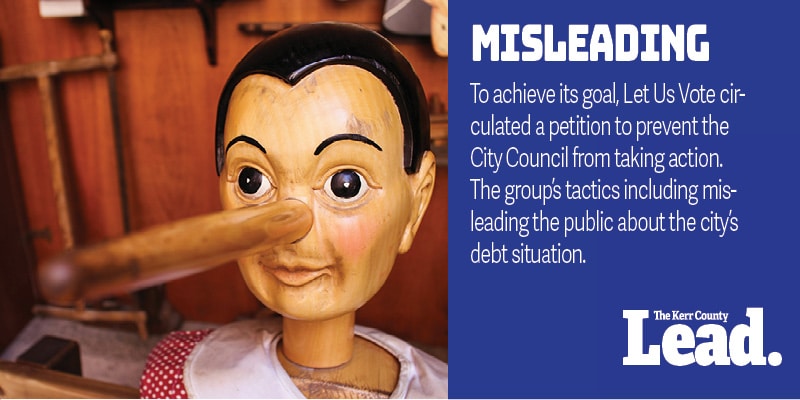
No one could counter the most ludicrous allegations, thanks to the City Council and staff’s inability to respond during public remarks. Sources told The Lead that the petitioners told them the city was $60 million in debt, and that was it.
Here’s how the city’s debt service works.
- General Fund Debt. Before 2022, when voters approved the bond to pay for the public safety building, the taxpayers were on the hook for very little debt. The debt was so manageable that paying it back required no raises to the city’s tax rate or property taxes. The city’s two significant revenue sources are sales and property taxes. When the voters approved the $45 million public safety bond, it resulted in a 13% increase in property taxes. As of Monday, the city owes $55 million from its general fund, and for nearly 80% of that debt, the voters said yes to raising taxes.
- Water Fund Debt. Water is not free. Water systems require massive public investment, and in 2018, Kerrville needed to spend money on its reuse ponds, improving filtration to keep out total trihalomethanes, a byproduct of water treatment. Water treatment requires chlorine additives to keep out the truly nasty stuff, like E. coli and salmonella. But there’s a potentially toxic byproduct — TTHMs. Water providers must report their findings to the state. Before 2018, Kerrville had problems controlling these TTHMs and spent more than $4 million to fix the issue. Since those fixes, Kerrville has self-reported TTHM violations six times to the Texas Commission on Environmental Quality. As of Monday, there is $48 million in debt.
- Finally, the Economic Improvement Corp. earns revenue from a half-cent sales tax allotment to invest in city projects, including quality of life. Most of the money is invested, with an independent EIC board of directors deciding on projects to spend money on. For instance, they can borrow money to pay for large-scale projects as they did with a certificate of obligation to pay for improvements to the Cailloux Theater, Scott Schreiner Golf Course and the Olympic pool. However, the city’s wastewater reuse pond is one of the most significant outstanding chunks. As of Monday, the EIC owes $27 million in debt, but the money comes directly from that half-cent sales tax, which is covered not only by residents purchasing inside the city but also by those who live outside the city limits.

When Puccio and her crew fanned out across Kerrville, they left out the above bits because they were an inconvenient truth.
“I have a very good idea where your constituents are at,” Puccio told the City Council during an Aug. 24, 2021, meeting. “They believe that, outside of emergencies, we should always vote on debt.”
In 2010, the City Council set a policy that large-scale projects would be put on the ballot for voter approval, which was the likely direction the city would take with the public safety building. The city’s policies do not allow borrowing beyond 25% of the city’s tax rate.
And the looming infrastructure monster is centered around water. The city has a list of $100 million of future water projects, which is not uncommon for cities.
Thanks to limited federal assistance, cities and water districts have invested billions to protect drinking water resources, which required debt assigned to ratepayers. Kerrville’s topography makes water treatment and transport tricky, requiring expensive lift stations. The city is working to catch up on years of deferred maintenance, including recently replacing nearly century-old water pipes. Water systems are also fragile, requiring constant replacement, maintenance and upgrades.
Was any of that explained to the petitioners? Of course not.
With the bare minimum of signatures, the Let Us Vote crowd got what it wanted — the certificate of obligation stopped. That left the city scrambling to create a new plan to build a public safety building.
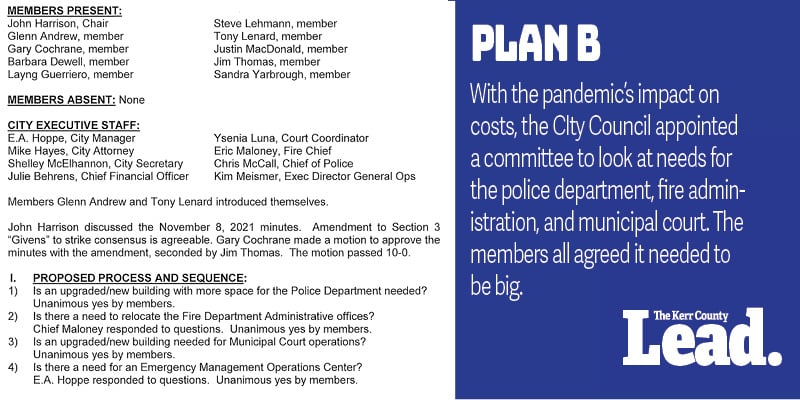
The City Council voted to appoint a 10-member citizen panel to recommend the new public safety building. The city’s one problem was a 2019 plan that had remained confidential about the public safety building. That plan recommended building on existing city-owned property, including a plan to build around the current police station. In the chaos of Let Us Vote’s efforts, Kerr County Judge Rob Kelly bought up the land around the station to potentially expand Kerr County services.
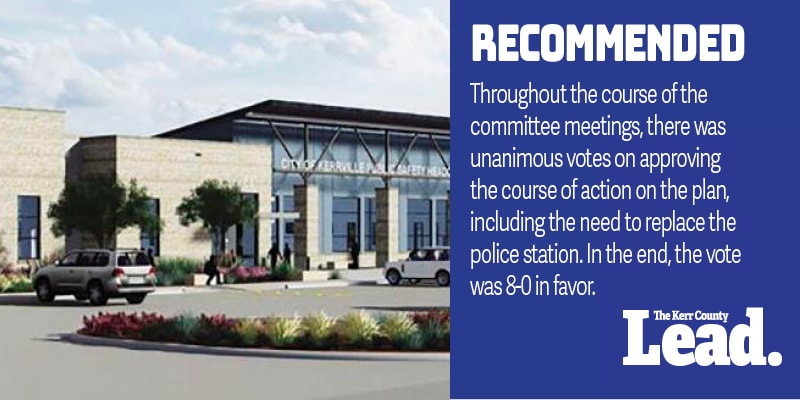
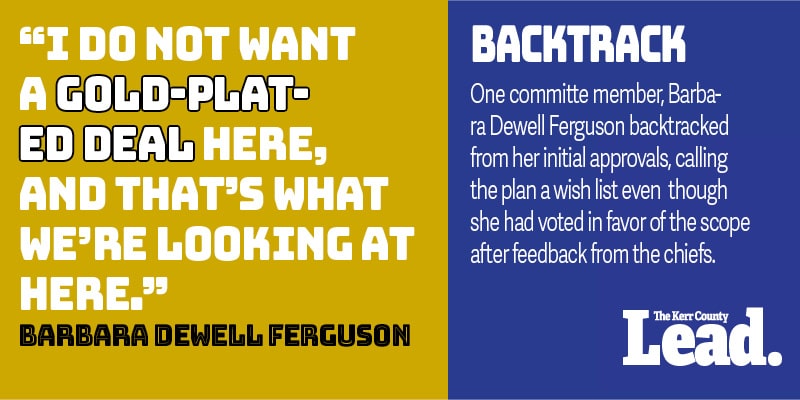
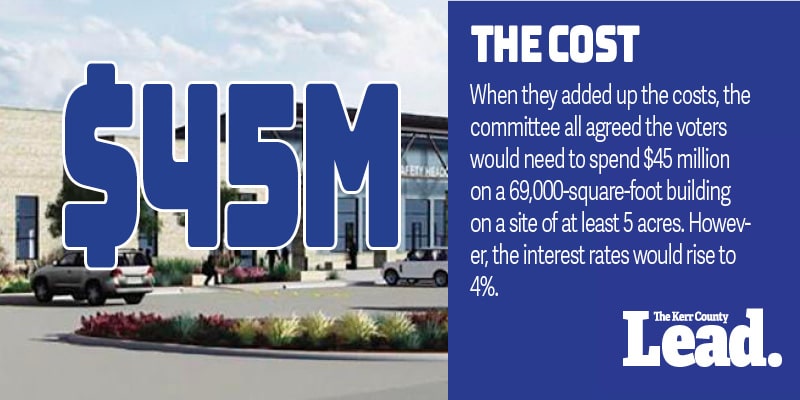
However, in five meetings, the 10-member panel developed a unanimously approved plan until one member backed out. That member was Barbara Dewell Ferguson, who said she supported spending $45 million on the 69,000-square-foot building but wouldn’t vote on the final proposal.
“I do not want a gold-plated deal here, and that’s what we’re looking at here,” Dewell Ferguson said in early 2022.

The City Council put the bond on the ballot with a unanimous vote. However, thanks to the efforts of We The People Liberty In Action and others, the cost to taxpayers jumped from 2.8% for an initial outlay of $7 million to a nearly far more expensive endeavor—one with an interest rate of 4%. In the end, raising taxes rested with the voters’ will, but it was activists who made it more expensive.
Author
Related Articles
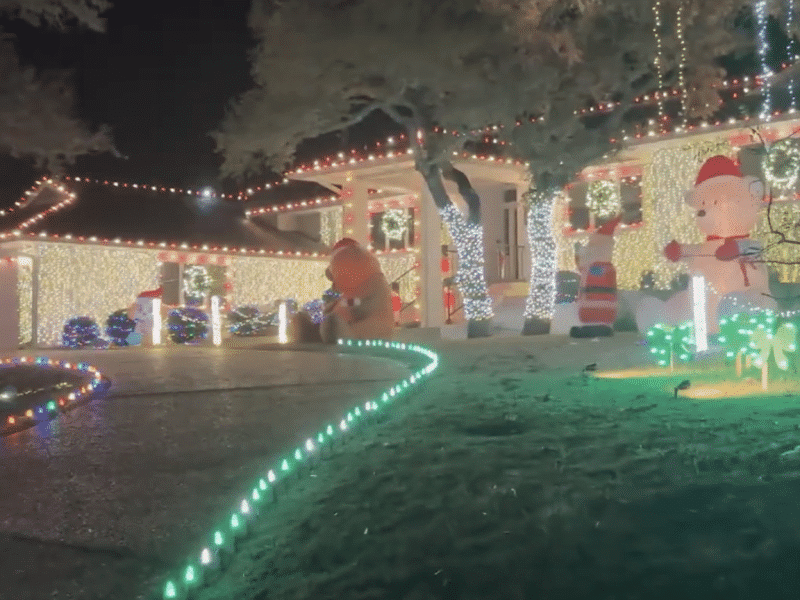
502 Riverhill Blvd. wins 2025 KPUB Kerr County Christmas Light Tour, event ends after five years
The tour, sponsored by Kerrville Public Utility Board, featured video showcases of each finalist shared on The Kerr County Lead’s Facebook and YouTube channels, where community members voted for their favorites.
Holiday cheer, live music and community gatherings fill week ahead
The calendar features more than 50 events across seven days, ranging from support groups and wellness programs to holiday markets and live entertainment, offering something for nearly every interest and age group.

Texas wildlife officials warn of avian flu risk as migratory birds arrive
The virus poses particular risks to domestic cats, skunks, foxes, raccoons, bobcats, mountain lions and black bears, which typically contract the disease by consuming infected animal carcasses. Backyard poultry can also become infected through contact with wild birds.
Comments (0)
There are no comments on this article.