
Belew’s day in court is here; his defense rests on defining “final conviction”
The issue facing 198th District visiting Judge Sid Harle today is whether Belew is qualified to continue to serve on the Kerr County Commissioners Court. Guiding Harle’s decision determines if Belew’s 1973 conviction in a burglary ring was final or something else.
After four months of waiting around, sifting through documents and memories, Kerr County Precinct 1 Commissioner Harley David Belew faces reckoning over his political future at 10 a.m. today.
The issue facing 198th District visiting Judge Sid Harle today is whether Belew is qualified to continue to serve on the Kerr County Commissioners Court. Guiding Harle’s decision determines if Belew’s 1973 conviction in a burglary ring was final or something else.
Belew’s attorney, Patrick O’Fiel, will argue that there’s no “clear and convincing” evidence that Belew received a final conviction. O’Fiel will say the state’s evidence does not indicate that Belew’s conviction was final because it’s missing a signature from the judge. The defense will also attempt to convince the judge that Tarrant County, where Belew lived at the time, had an early form of deferred adjudication for young offenders like Belew, who was 17 at the time of the robberies.


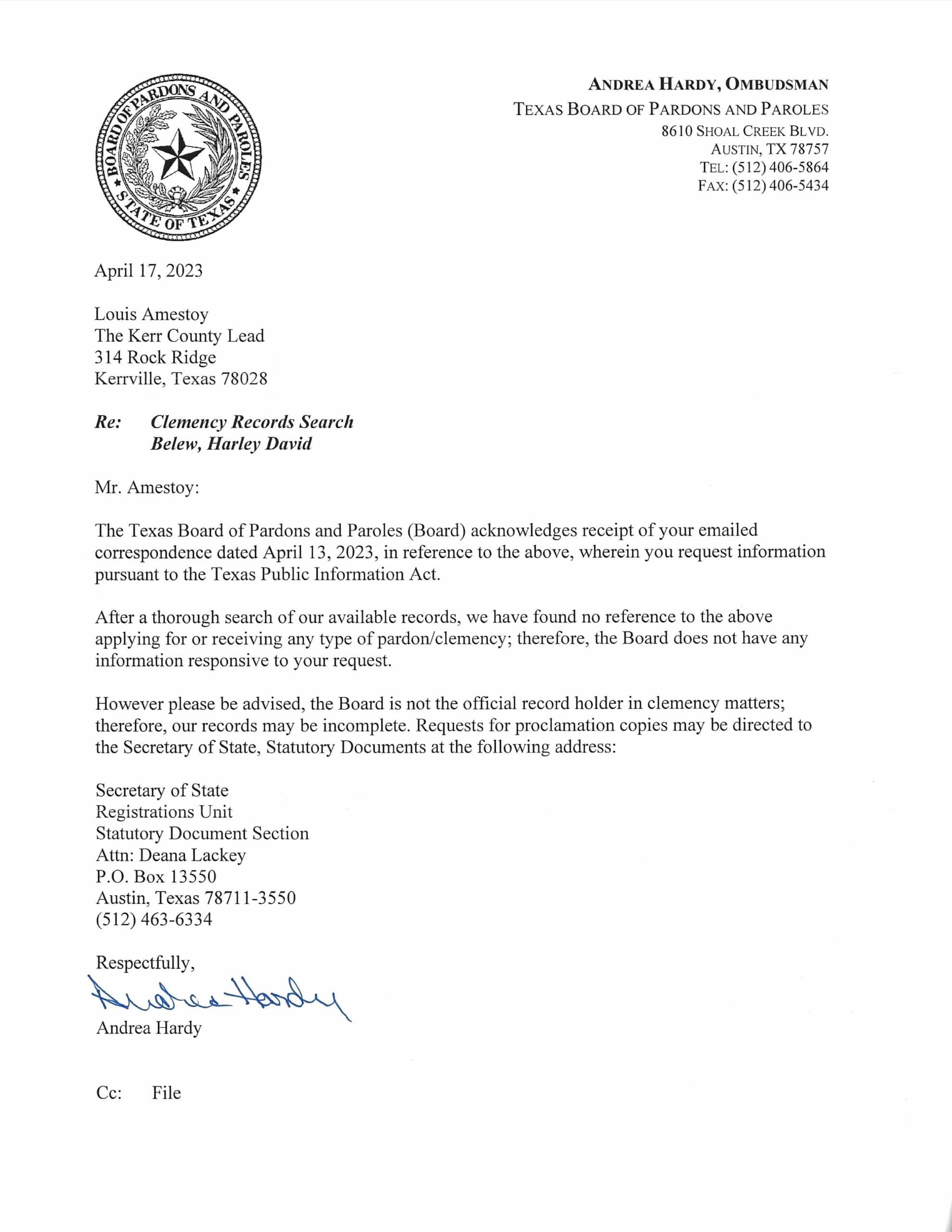
But in a quo warranto proceeding, the burden of proof is on the defense. Belew admits the three indictments in an affidavit but said his late attorney told him he wouldn’t face a felony record.
“It is my understanding that (Frank Coffey) in creating what is now deferred adjudication, a ‘court of no record for teen offenders and was instrumental in rewriting of the Texas Code of Criminal Procedures in 1973-1974,” Belew wrote. “I completed my probation without revocation and the probation was administratively closed.”
The only problem with Belew’s defense is that no one told the Department of Public Safety to remove him from its database of felons. And while Belew argues he was a teen offender, Texas treats 17-year-olds as adults and has done so for a century. Texas is one of only four states that still prosecute 17-year-olds as adults.
In Belew’s defense, Frank Coffey was a Tarrant County District Attorney from 1965 to 1973 and later served as a judge from 1982 to 1990. Coffey died in 2002 at 74. He was also a Democrat who apparently believed in criminal justice reform by helping reshape the state’s penal code.
Belew will also argue that restoring the right to vote is intertwined with the right to hold public office. O’Fiel’s central theme is that the First Amendment protects Belew’s quest to serve on the commissioner’s court in 2016 and 2020, where he swore he had no felony record. The Kerr County Republican Party never ran a background check to see if any candidates had disabilities preventing them from serving.
The quo warranto action argues that Belew was never qualified to serve based on the felony conviction. Texas law suggests that the only remedy for forgiveness is a pardon or another judge’s action to relieve him of a felony disability. There’s no evidence of a clearing, and a felony stays on your record forever — frequently preventing felons from holding some jobs.
The defense and 198th District Attorney Stephen Harpold are asking for a summary judgment — leading to a wave of court filings in the last two weeks.
On Sept. 20, Harpold responded to O’Fiel’s motions by saying that Belew’s waiving of a trial and guilty plea resulting in a decade of probation are material facts supporting a final conviction.
Harpold’s filings argue:
- A judge’s signature on a plea agreement became law in 1981.
- The Belew acknowledged in his plea agreement that the court “ordered, adjudged and deccreed” an admission of guilt.
- That Belew’s defense is trying to apply today’s standards to 1973 standards.
And in one request from Judge Harle, Harpold said that removal would not affect Belew’s past votes on the court. If Harle decides to remove Belew, Kerr County Judge Rob Kelly said he would wait for the appellate process to run its course before naming a replacement.
Author

Related Articles
Kerrville cuts ribbon on $45M Public Safety Complex, placing it ‘in service’
What makes Thursday’s opening remarkable is that for all three departments moving in, it marks the first time they have ever occupied a facility built for their actual purpose. T

Peterson Health ranked among top 20 rural hospitals in the nation
The Kerrville hospital will be formally recognized May 21 at NRHA’s Annual Rural Health Conference in San Diego.

Kerr County to test emergency alert systems April 2
The test will include the Integrated Public Alert and Warning System, which pushes alerts to all mobile devices in the area, and the CodeRED notification system for registered users.
Comments (0)
There are no comments on this article.