
Heart health experts emphasize prevention, symptom awareness during February’s awareness month
Peterson Health specialists discuss lifestyle changes, gender differences in cardiac care during Lead Live segment
Heart disease doesn’t always announce itself with crushing chest pain, and the best treatment often begins long before symptoms appear.
Those were among the key messages from Peterson Health experts Jenna Cummings and Jessi Kearns during the Feb. 2 episode of The Lead Live, where the two specialists outlined practical approaches to cardiovascular wellness during Heart Health Month.
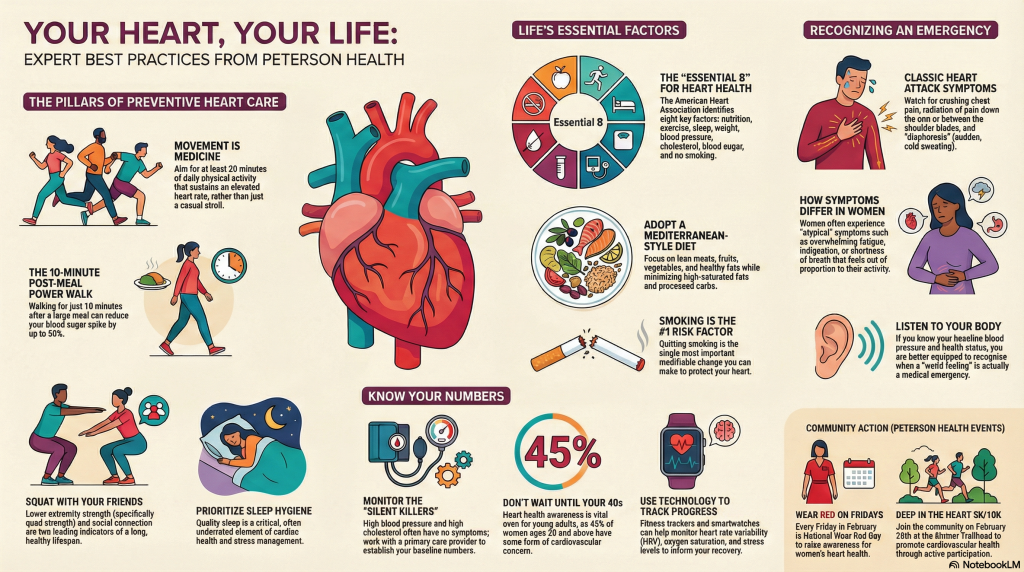
Cummings, a nurse practitioner in cardiac care, emphasized that prevention beats intervention every time. She pointed to the American Heart Association’s “Life’s Essential 8” framework as a roadmap for managing modifiable risk factors including nutrition, exercise, sleep, blood pressure, cholesterol, blood sugar control and smoking cessation.
“Nobody wants to put anybody on medication, and so preventative heart care is really your step to doing modifiable life changes such as eating healthy and getting some kind of physical activity at least 20 minutes a day — actually getting your heart rate up, not maybe just strolling to the mailbox,” Cummings said.
Women face different risks
A significant portion of the discussion centered on how heart attack symptoms present differently between men and women — a knowledge gap that can prove deadly.
While men typically experience textbook symptoms like crushing chest pain radiating down the arm, women often face subtler warning signs that are frequently dismissed as minor ailments.
“In women, sometimes it presents as just overwhelming fatigue,” Cummings said. “And so it’s often mislooked. That’s why women have a higher death rate. Because they just blow it off on a little indigestion and fatigue.”
Other atypical symptoms in women include shortness of breath out of proportion to activity and what might feel like simple indigestion. Many women arrive at the hospital saying they had no idea they were experiencing a cardiac event, according to Cummings.
Movement and muscle as medicine
Kearns, Peterson Health’s wellness coordinator, focused on the practical application of fitness principles, particularly the concept of “intensity minutes” — ensuring exercise is vigorous enough to raise the heart rate rather than simply accumulating steps.
She offered a specific intervention for blood sugar control: “A 10-minute walk post-meal, a large meal, can reduce your blood sugar spike by up to 50%.”
Kearns also connected two often-separate health priorities into what she called a longevity formula.
“Two of the leading indicators of longevity is connection and lower extremity strength,” Kearns said. “I tell people I’m going to make shirts that say ‘squat with your friends’ because that’s how you live a long time.”
The emphasis on maintaining quad strength addresses a critical issue for aging populations: muscle loss that contributes to falls, reduced mobility and declining independence.
Technology and medication realities
Both experts discussed the role of modern tools in heart health monitoring and management.
Kearns advocated for wearable technology like Garmin watches and Apple Watches to track metrics including heart rate variability, stress levels and sleep quality — data that can indicate when the body needs more recovery time.
The conversation also addressed GLP-1 medications like Ozempic, which have surged in popularity for weight loss. While acknowledging their medical value, Kearns cautioned against viewing them as standalone solutions.
“It is important to combine some sort of resistance strength training with that because it is going to start to deteriorate or eat at those muscles just as much as it takes down that fat,” Kearns said.
The medication-induced muscle loss, combined with fat loss, requires intentional strength training and proper hydration to prevent harmful body composition changes.
Community events
Peterson Health will host the Deep in the Heart race on Feb. 28 at the Schreiner Trailhead, featuring 5K and 10K options to promote community health and awareness.
Additionally, Cummings noted that Fridays throughout February are designated “wear red days” to raise awareness for women’s heart health — a recognition of the gender-specific challenges in cardiac care diagnosis and treatment.
Both experts encouraged residents to establish baseline health metrics with primary care providers rather than waiting until problems develop, emphasizing that early intervention through lifestyle modification remains the most effective strategy for long-term cardiovascular health.
Author

Related Articles

More than 200 turn out for unwieldy marathon Kerr County GOP forum
Hughes, Vela absent after receiving “Reservations”; candidates excluded from voter guide participate in three-hour event

Kerr Together opens disaster relief center, marking shift to long-term recovery
Kerr County Judge Rob Kelly and Kerrville Mayor Joe Herring Jr. issued a joint proclamation formally recognizing the center and the recovery group’s governance role.

BREAKING: Kerrville man arrested in kidnapping case after victim recovered in Somerville
Anthony Harwell was booked into the Burleson County Jail following his arrest early Tuesday in Somerville, where the 38-year-old victim was found safe, according to the Kerrville Police Department.
Comments (0)
There are no comments on this article.