
Kerr County officials detail response to deadly July 4 flood
Kerr County officials testified Thursday about their response to a catastrophic July 4 flood that killed 108 people, including 37 children, during an unprecedented joint legislative hearing examining the disaster.
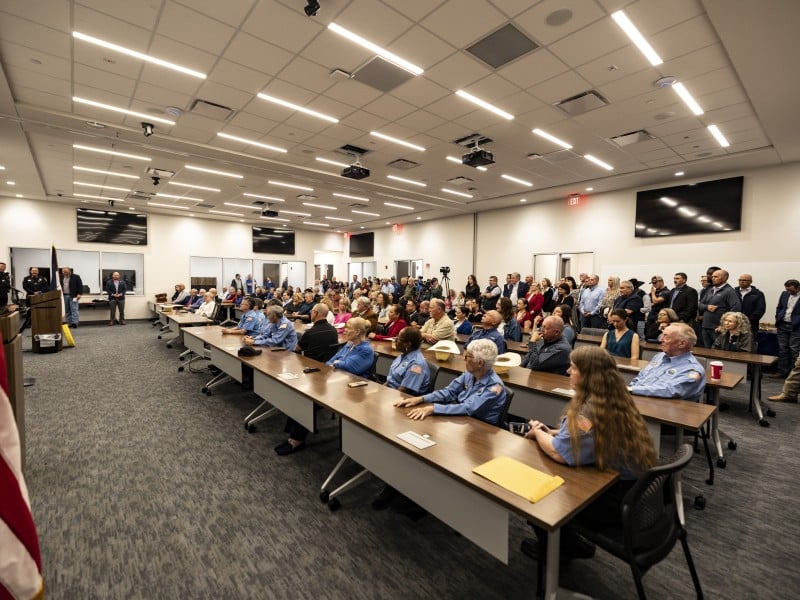
County Judge Rob Kelly, Sheriff Larry Lee Leitha and Emergency Management Coordinator William “Dub” Thomas IV appeared before the joint Senate and House Select Committees on Disaster Preparedness and Flooding at the Hill Country Youth Event Center.
‘Thousand-Year Flood’ Overwhelmed Region
Kelly testified that an independent hydrology study commissioned by the county confirmed the event was a “thousand-year flood” that dumped more than 12 inches of rain in under six hours across remote areas of the watershed.
The first 911 call came at 2:53 a.m. from the River Inn Resort, Kelly said. Within 37 minutes, floodwaters had overtaken multiple river crossings as water levels rose more than 20 feet per hour. River flows at Hunt exceeded 220,000 cubic feet per second.
“This event was not foreseeable using today’s detection systems, was not forecasted by the National Weather Service or TxDOT, and was not expected by our emergency response team,” Kelly said.
Kelly said he was at his lake house July 3 preparing for a family gathering when “nothing felt out of the ordinary in town.” His first indication the storm was different came when he woke to calls from emergency officials after flooding had already overtaken several upstream camps.
No Warning of Catastrophic Event
Sheriff Leitha said his deputies had “no idea, no warning that there was going to be a major tsunami-like event on the South Fork.” He went to bed July 3 with “zero worries” as weather reports were positive.
“I have never seen anything like this before,” said Leitha, a lifelong resident and veteran law enforcement officer. “It was devastating.”
One dispatcher team handled 615 radio transmissions and more than 100 emergency calls in the first few hours, with one dispatcher staying on the line for 24 minutes with two children whose cabin was filling with water.
Rural Resources Stretched Thin
The flood exposed critical gaps in rural emergency preparedness. With only six deputies on shift and limited swift-water rescue equipment, first responders — many of them volunteers — conducted hundreds of rescues by boat, aircraft and from rooftops.
“The majority of our firefighters are volunteers with little specialized swift-water equipment or training, yet they did not hesitate,” Leitha said.
Emergency Management Coordinator Thomas noted that multiple flash flood warnings were issued through the National Weather Service’s alert systems, but forecasts called for typical summer flooding of “1 to 3 inches, possibly as much as 7 inches” — not the catastrophic deluge that occurred.
“Based on the data we had at the time, there was no clear indicator that a catastrophic flood was imminent,” Thomas said. He was off duty due to illness July 3 but began coordinating the county’s response by 6 a.m. July 4.
Calls for Improved Warning Systems
All three officials emphasized the need for better real-time monitoring of upstream rainfall and river gauges, particularly in remote watershed areas where the storm struck.
Kelly requested stronger state support for rural emergency management, including additional staffing, swift-water rescue equipment and training. He also called for improved communications infrastructure, noting that poor cell service and overwhelmed 911 lines forced calls to be rerouted to other counties.
Thomas advocated for a “proactive, not reactive” approach to flooding, describing the tragedy as part of a larger trend of increasing inland flooding that requires a statewide response.
Kelly emphasized the county’s commitment to transparency, noting his office has received more than 100 public information requests and is cooperating fully with investigations.
“We have nothing to hide,” Kelly said.
Two people remain missing from the flood, which officials called the most devastating event in Kerr County history.
Author

Related Articles

Arts, outdoors events fill Kerr County calendar for week of April 6-12
The Cailloux Theater bookends the week with two marquee performances. Swan Lake arrives Thursday at 7 p.m., followed Sunday at 4 p.m. by Waterloo: A Celebration of ABBA. Tickets for both are available at caillouxperformingarts.com.
Kerrville cuts ribbon on $45M Public Safety Complex, placing it ‘in service’
What makes Thursday’s opening remarkable is that for all three departments moving in, it marks the first time they have ever occupied a facility built for their actual purpose. T

Austin’s to-do list carries big implications for Kerr County — and a few surprises for New Mexico
The Texas House of Representatives has its homework assignment for the months ahead, and Kerr County is written into nearly every chapter of it.
Comments (0)
There are no comments on this article.