
Legislative leaders signal flexibility on camp internet mandate, but deeper licensing questions loom
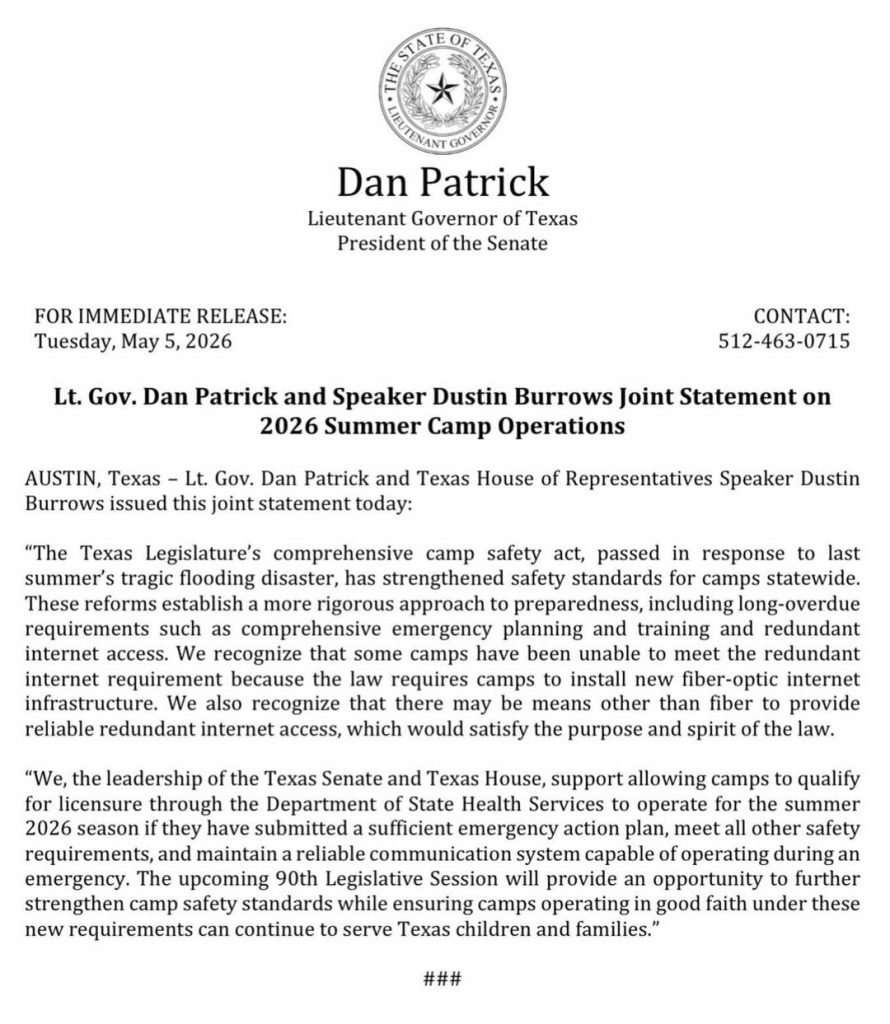
The two leaders, in a statement released Tuesday from Patrick’s office, acknowledged that the Heaven’s 27 Camp Safety Act — passed by the Legislature in special session following the July 4, 2025 flood that killed 28 people at Camp Mystic — created an unworkable standard for many camps.
Lt. Gov. Dan Patrick and Texas House Speaker Dustin Burrows issued a joint statement Tuesday signaling that Texas camps unable to meet a fiber-optic internet mandate tied to last summer’s flood disaster may still qualify for state licenses this summer — a development that offers relief to many rural camps but leaves unresolved a separate provision that could permanently bar river camps from operating.
The statement stops well short of addressing what may be the more consequential barrier facing Kerr County camps specifically.
What Patrick and Burrows said
The two leaders, in a statement released Tuesday from Patrick’s office, acknowledged that the Heaven’s 27 Camp Safety Act — passed by the Legislature in special session following the July 4, 2025 flood that killed 28 people at Camp Mystic — created an unworkable standard for many camps.
The law, codified at Texas Health and Safety Code Section 141.0092, requires every licensed youth camp to maintain two internet connections: a primary connection through end-to-end fiber-optic infrastructure, and a secondary connection through a separate broadband provider. For many rural camps, fiber service either doesn’t exist or would cost hundreds of thousands of dollars to install.
Patrick and Burrows said camps should be allowed to qualify for licensure through the Department of State Health Services for the 2026 summer season if they have submitted a sufficient emergency action plan, meet all other safety requirements, and maintain what they called “a reliable communication system capable of operating during an emergency.” They said the upcoming legislative session would provide an opportunity to revisit the standards.
“We also recognize that there may be means other than fiber to provide reliable redundant internet access, which would satisfy the purpose and spirit of the law,” the statement read.
Context: the lawsuit
The statement comes roughly three weeks after 19 Texas youth camps filed suit in Travis County’s 126th Judicial District Court challenging the constitutionality of the fiber-optic mandate. The camps — which collectively serve more than 40,000 youth campers annually — argued that the requirement was physically unavailable or prohibitively expensive for rural operators, with installation cost estimates ranging from $35,000 to more than $900,000.
Among the plaintiffs is UBarU Camp and Retreat Center, operated by the Unitarian Universalist Friends Retreat Foundation near Kerrville — the only Kerr County camp among the 19 plaintiffs.
The camps were not challenging the redundant internet concept itself, only the requirement that one connection specifically be end-to-end fiber. The Patrick/Burrows statement essentially validates that position.
The provision they didn’t address
For Kerr County’s river camps, the fiber question may be the easier problem.
Section 141.0052 of the Health and Safety Code — also added by the Heaven’s 27 Act — prohibits DSHS from issuing or renewing a youth camp license for any camp operating cabins within a floodplain, with limited exceptions. A camp may still be licensed if its cabins are near a still body of water not connected to a moving waterway, or if each cabin sits at least 1,000 feet — roughly a quarter mile — from a regulatory floodway.
For camps built along the Guadalupe River and its tributaries, that standard presents a geographic problem that no policy statement can resolve. Camp Stewart, Camp Waldemar, and La Junta camps are all situated near the river corridor. Camp Mystic, where 28 people died in the July 4 flood, has already announced it will not hold camp this summer.
Unlike the fiber requirement, the floodway provision carries no waiver authority. The statute explicitly strips DSHS of the ability to grant exceptions.
The map question
Adding further uncertainty: it is not yet clear which FEMA flood maps DSHS intends to use to determine floodway boundaries.
SB 1 defines a floodway as an area identified on “the most recent flood hazard map” published by FEMA. The most recent map covering Kerr County is a Base Level Engineering map released in May 2025 — but that map is preliminary and advisory, and has not gone through the formal adoption process that makes a Flood Insurance Rate Map legally binding. The prior official FIRM dates to 2011.
Depending on which map DSHS applies, the floodway boundaries — and the quarter-mile buffer measured from them — could differ significantly for individual camp properties.
The Lead sent DSHS an email Tuesday seeking clarification on which map the agency is using. No response had been received as of publication.
No Kerr County camp re-licensed
As of today, no youth camp in Kerr County has received a renewed license from DSHS for the 2026 season. How camps along the river corridor will contend with the floodway provision — and which map will determine their fate — remains unanswered.
Author

Related Articles

Hill Country Charity Ball shatters 39-year fundraising record with $222,000 haul
The 39th Annual Hill Country Charity Ball raised $222,000 for five local beneficiaries, breaking the organization’s all-time fundraising record by $62,000 and surpassing last year’s total by more than $82,000.

Kerr County gas now averaging $4.21; prices climb for third straight day
A year ago, Texans were paying an average of $2.76 per gallon, a roughly $1.28-per-gallon difference from today.
Severe thunderstorm watch in effect for Kerr County until 1 p.m.
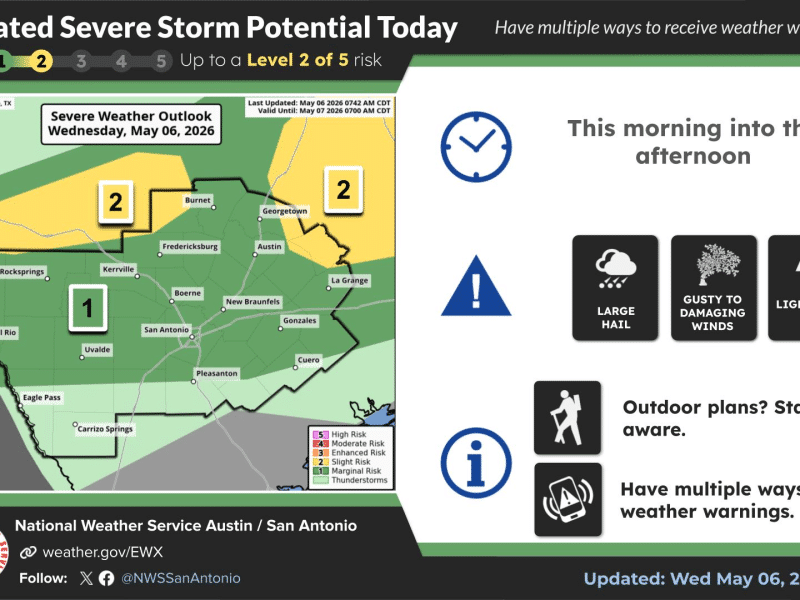
The National Weather Service Storm Prediction Center issued Severe Thunderstorm Watch 185 for Kerr County and 22 surrounding counties Wednesday morning, in effect until 1 p.m. CDT.
Comments (0)
There are no comments on this article.