
Flood warning sirens going up in West Kerr County as alert system takes shape
Audible testing begins Wednesday along FM 1340, SH 39 corridors
The Upper Guadalupe River Authority began installing the first phase of outdoor warning sirens in West Kerr County this week, a milestone in a broader, multi-year flood warning system built through a collaborative network of local governments and emergency managers.
Residents west of Ingram, along FM 1340 and State Highway 39, may hear brief tests of the newly installed sirens through May 15. Each test will include a tone and a pre-recorded voice message identifying it as a test.
“It is a component of the larger flood warning system,” UGRA General Manager Tara Bushnoe said. “The big picture is still the plan, and it’s going to be built out in phases — all the data comes in from our rainfall and water level sensors, it’s assimilated, there’s different thresholds that are met, and then you have different communication methods for it to go out. And one of those is the sirens.”
The working group behind the project includes UGRA, Kerr County, the cities of Kerrville and Ingram, and local volunteer fire departments. The project is partially funded through Senate Bill 3, the state’s legislative response to the July 4, 2025 flood disaster that killed 135 people across the Hill Country, including 28 at Camp Mystic on the North Fork of the Guadalupe River.
The hardware
The first eight sirens are being installed by Omni Warn, a Federal Signal representative. Each unit consists of a 50-foot steel pole buried 10 feet into the ground, topped by a 12-foot speaker stack — bringing the total installed height to 52 feet.
“These are capable of doing multiple tones and voice,” said Ryan Dean, Omni Warn’s representative on the project. “Different tones depending on the emergency. Our preferred method is pre-recorded voice messages uploaded to an SD card on the siren.”
The sirens also have live public address capability through a microphone, and emergency managers can program them for emergencies beyond flooding — including wildfires and chemical spills.
Dean was direct about what the sirens are and aren’t designed to do.
“We specifically use the term outdoor warning sirens because they are meant to alert people who are outside,” he said. They are designed as one layer of a multi-channel system that also includes cell phone alerts and weather radios.
Placement and topography
The first six sirens are being positioned along the North Fork and South Fork corridors — areas the state has identified as higher-risk because of a compressed window between rainfall onset and rising water levels.
“We know that along the North Fork and South Fork that we have a really short response time between when it starts to rain and when the water starts to rise,” Bushnoe said.
State regulations require electronic components be located outside the 500-foot floodplain — a requirement that ruled out many low-lying public rights-of-way along FM 1340 and SH 39.
“That’s why the choice was to go up on private property,” Bushnoe said. UGRA secured easements on elevated private parcels to meet the state requirement.
To account for the Hill Country’s canyon and valley terrain, Omni Warn used acoustic modeling software called Sound Plan to map how sound will travel under varying conditions.
“Topography plays a huge role in sound propagation,” Dean said. “It takes into consideration the changes in elevation, temperature, humidity, wind direction. We can model all different kinds of scenarios.”
The data layer
Behind the sirens is a network of rainfall and water level sensors feeding into an integrated monitoring dashboard that emergency managers have had access to since December.
A public-facing version of that dashboard — called Riverhub — is expected to launch at the end of May. Real-time data will also be displayed at Kerrville Police Department dispatch in the new public safety building.
“Through this integrated dashboard, we’re going to be able to see more holistically what rainfall and water levels are and then have different thresholds based off of that,” Bushnoe said.
UGRA this week also launched a dedicated section of its website documenting the full Guadalupe River Flood Warning System project at ugra.org/floodwarning.
Testing schedule and community questions
Audible testing is scheduled May 7–15. UGRA will post updates on its Facebook and Instagram pages — @UGRAtx — beginning Thursday. Residents with questions about the testing can call Kerr Together at 830-315-1002.
Individual sirens will be tested as each is installed. A comprehensive system test is planned after installation of the first phase is complete.
Author

Related Articles

Hill Country Charity Ball shatters 39-year fundraising record with $222,000 haul
The 39th Annual Hill Country Charity Ball raised $222,000 for five local beneficiaries, breaking the organization’s all-time fundraising record by $62,000 and surpassing last year’s total by more than $82,000.

Kerr County gas now averaging $4.21; prices climb for third straight day
A year ago, Texans were paying an average of $2.76 per gallon, a roughly $1.28-per-gallon difference from today.
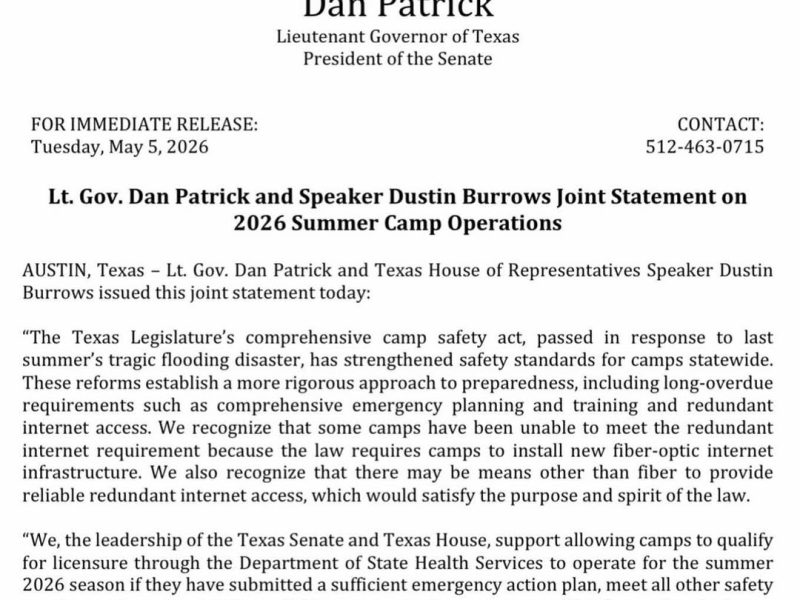
Legislative leaders signal flexibility on camp internet mandate, but deeper licensing questions loom
The two leaders, in a statement released Tuesday from Patrick’s office, acknowledged that the Heaven’s 27 Camp Safety Act — passed by the Legislature in special session following the July 4, 2025 flood that killed 28 people at Camp Mystic — created an unworkable standard for many camps.
Comments (0)
There are no comments on this article.