
Volunteers replant the Guadalupe as Kerrville nears the flood’s one-year mark
The Kerr County River Foundation’s Adopt-A-River program reports some 1,500 volunteer hours and thousands of new plantings, while the Community Foundation details $82 million in regional recovery grants.
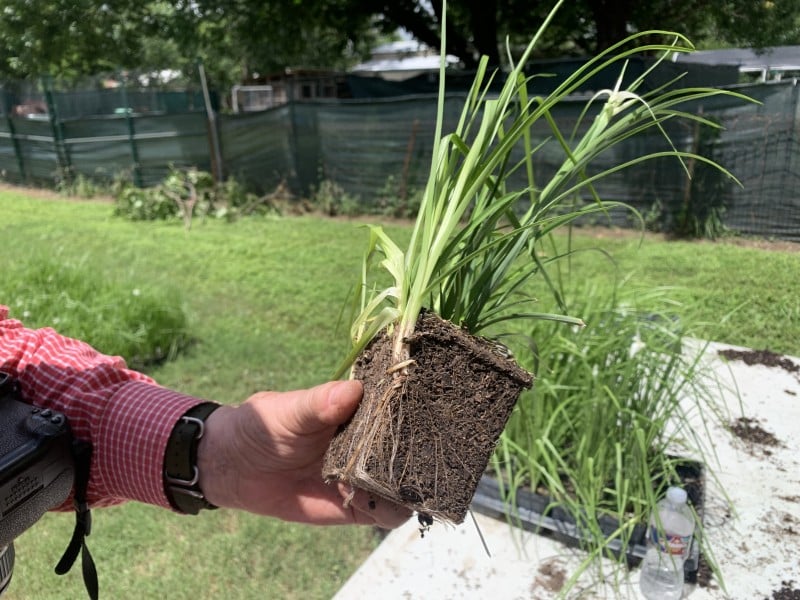
A year of volunteer labor along the Guadalupe River has produced more than 250 trees, nearly 2,000 cuttings and over 1,200 native grasses and pollinator plants — an estimated $75,000 worth of restoration work for about $7,000 spent so far, the Kerr County River Foundation told the Kerrville City Council on Tuesday.
Jeremy Walther, updating the council on the foundation’s Adopt-A-River Trail program, said the roughly 1,500 volunteer hours logged since the program launched earlier this year are the early returns of a restoration partnership with the city, funded by a $150,000 grant from the Community Foundation of the Texas Hill Country.
The program began with a one-mile stretch of the River Trail, divided into five sections, running from the G Street trailhead to Schreiner University. This spring it added a sixth section at the Francisco Lemos bridge behind the Riverside Nature Center and Lowry Park, which has been adopted by the Kerrville Public Utility Board.
Walther said the foundation has built two ArcGIS mapping applications: one that assesses flood damage and generates a “restoration priority index” to steer partners toward high-impact sites, and a public app that lets residents contribute “photo monitoring” by uploading repeat photos from fixed points along the river and creeks to track recovery over time.
Because the trail crosses private property, the foundation works with landowners — among them community activist Barbara Burton — to secure planting permission and maintain access. It has also partnered with the San Antonio Botanical Garden’s tree initiative to plant tens of thousands of trees along a 30-mile corridor, and the botanical garden, Texas Parks and Wildlife and Schreiner University are developing a satellite nursery on Schreiner’s campus to grow restoration-ready native grasses and trees.
Walther detailed several operational hurdles. To water new plantings, the foundation upgraded from a 500-gallon gravity-fed tank to a donated one-ton flatbed truck and a 12-foot trailer that together carry 2,250 gallons, refilling on-site tanks weekly. The water comes from the river under a temporary TCEQ permit during high flows and from treated city wastewater when flows are low. To protect new plantings from exotic axis deer, the foundation is continuing a deer-trapping program, while the Texas Master Naturalists — who adopted the first section — are running a trial of eight tree-protection methods to find the most effective.
Foundation reports $82 million in regional recovery, $10 million to the city
The workshop’s second presentation came from Austin Dickson, CEO of the Community Foundation of the Texas Hill Country, who marked the flood’s approaching one-year anniversary with an update titled “Recovery is Real.”
Dickson said the foundation has granted $82 million across the region over the past year, including $10 million directly to the City of Kerrville. The July 4 flood killed 137 people across the region, including 119 in Kerr County.
The foundation’s case-management hub, RebuildKerr.org, has registered 650 survivor cases and closed 138 of them with all needs met, Dickson said. The foundation fully funds the salaries of 32 local case managers. Housing, he told the council, remains survivors’ single largest and most critical long-term need.
Of the $10 million granted to the city, the largest share — $8.4 million — will rebuild Louise Hays Park, the foundation’s second-largest recovery grant to date. Dickson said the money will pay for a new playground, splash pad, parking and a dog park.
Other city allocations include $460,000 to replace the Camp Meeting Creek bridge and add trash cans, pet waste stations and benches along the River Trail; $400,000 to the Kerr Economic Development Corporation for national tourism advertising; $200,000 to the Convention and Visitors Bureau for an 18-month public memorial planning effort built around its community art program; $40,000 to restore electrical infrastructure on Tranquility Island; $10,000 for formal Kerrville Police Department dress uniforms for officers representing the city at memorial and public events; and more than $10,000 to the CVB to repair the murals beneath the Louise Hays Park bridge.
On housing, Dickson said 74 Kerrville households — 150 individuals — are living in temporary rental housing with rent and utilities covered by the foundation for up to a year. The foundation has paid off the property taxes of 108 qualified survivor households, including 31 in Kerrville, and has provided down-payment assistance to 20 families purchasing new homes. Six of those families are in Kerrville, among them a sheriff’s deputy, a middle school teacher and a firefighter.
The foundation has also invested $15 million in business recovery, helping more than 600 local businesses. That includes $12 million routed through LiftFund, which has issued grants of up to $50,000 and 43 interest-free loans of up to $500,000. Combined, Dickson said, the business grants have generated an estimated $100 million to $125 million in regional economic activity.
To address long-term trauma, the foundation has funded school-based counseling, first-responder support and grief programs. A $600,000 grant to Hill Country MHDD will open a walk-in emotional support center on Water Street, operating seven days a week beginning July 1, and the foundation is funding a mobile mental health app for Kerrville police officers and their families.
Dickson closed by telling the council that the pace of Kerr County’s housing recovery is recognized as among the fastest ever documented in American history.
Author

Related Articles

Kroc Center fan drive aims to collect 80 box fans for Arbor View residents
The Salvation Army Kroc Center is collecting new box fans this week for residents of Arbor View Nursing Home, aiming to gather 80 fans to help keep Kerrville seniors cool through the summer.
Screwworm tightens around Kerr County as state quarantines three counties to the south
The Texas Animal Health Commission drew a new infested zone over parts of Bandera, Medina and Uvalde counties Wednesday, leaving Kerr County — already under its own quarantine since June 9 — nearly ringed by detections.


Comments (0)
There are no comments on this article.