
Trust in doctors and health agencies shapes whether people know HPV causes cancer, MD Anderson study finds
Overall, 61.4% of those respondents knew that HPV can cause cervical cancer — a figure researchers note has been slipping in recent years even as the vaccine has become widely available.
Whether a person knows that the human papillomavirus causes cervical cancer may come down to a question that has little to do with the science itself: who they trust.
That is the central finding of a new study from The University of Texas MD Anderson Cancer Center, published June 24 in JAMA Network Open. Researchers found that U.S. adults who reported less trust in government health agencies or in their own doctors were measurably less likely to know that HPV — the most common sexually transmitted infection in the country — is the cause of nearly all cervical cancers.
The link matters because the tools to prevent cervical cancer already exist. The HPV vaccine prevents most HPV-related cervical cancers, and regular screening catches the disease early. Both depend on people first understanding that the virus and the cancer are connected.
“HPV vaccination and screening are powerful tools to prevent cervical cancer, but these tools depend on people understanding the link between HPV and cancer,” said corresponding author Sanjay Shete, Ph.D., professor of biostatistics and epidemiology at MD Anderson. “Our findings suggest trust is not just a background issue, but may directly shape whether people receive, believe and act on important cancer prevention information.”
What the researchers found
The team analyzed responses from 3,914 adults who had heard of HPV, drawn from the 2022 Health Information National Trends Survey, a nationally representative survey run by the National Cancer Institute.
Overall, 61.4% of those respondents knew that HPV can cause cervical cancer — a figure researchers note has been slipping in recent years even as the vaccine has become widely available.
Trust tracked closely with that awareness. Among adults who said they had a lot of trust in government health agencies for cancer information, awareness was highest, at 70.2%. Compared with that group, adults with only some trust had 29% lower odds of awareness, and those with little or no trust had 32% lower odds. A similar pattern held for doctors: adults with only some trust in physicians had 29% lower odds of knowing the link than those who trusted them a lot.
Religious organizations cut the other way. Adults who reported little or no trust in religious organizations as a source of cancer information had 88% higher odds of awareness than those who trusted them a lot. The authors suggest that faith-based settings often approach HPV through frameworks centered on abstinence and sexual conduct, which can limit open discussion of the virus and the vaccine.
Who is being missed
The study also surfaced gaps that did not depend on trust at all.
Men had 38% lower odds of knowing that HPV causes cervical cancer than women — a notable finding given that, as the authors point out, men are often household decision-makers on health matters. Non-Hispanic Asian adults had 69% lower odds of awareness than non-Hispanic white adults.
Education mattered too. Compared with adults holding a college or postgraduate degree, those with up to a high school education had 58% lower odds of awareness, and those with some college or a post–high school education had 53% lower odds.
One group stood out for higher awareness: adults with a personal history of cancer, who had 49% higher odds of knowing the link — likely a reflection of the information they encountered after a diagnosis.
What it means for prevention
The researchers frame their results as a roadmap for public health messaging at a moment when trust in institutions is under strain. The study notes that public trust in the federal government fell to 16% in 2023, its lowest point since 2011, and that trust in physicians and clinics dropped sharply over the same period.
Rather than treating those trends as background noise, the authors argue, public health campaigns should treat trust-building as the work itself. Their suggested strategies lean local and personal: national and community-based awareness campaigns, culturally tailored education, partnerships with trusted messengers, and engagement with faith and community organizations that can carry accurate information into settings where it might otherwise stall.
The study’s authors caution that its cross-sectional design cannot prove cause and effect, and that the survey’s response rate may limit how broadly the findings apply.
The study was funded by the National Cancer Institute (P30CA016672), the Betty B. Marcus Chair in Cancer Prevention, and the Duncan Family Institute for Cancer Prevention and Risk Assessment. The full paper and author disclosures are available in JAMA Network Open.
Author

Related Articles
One week in, more than 1 in 4 Kerr County voters have cast ballots
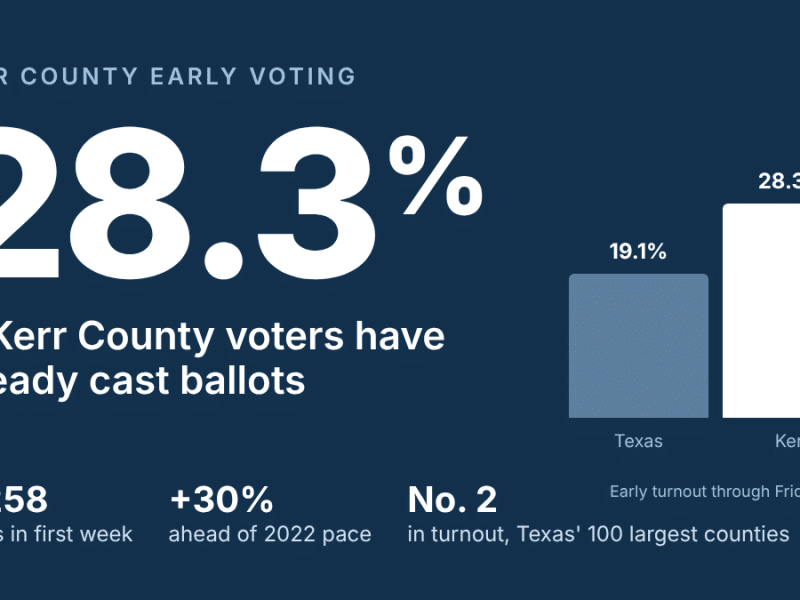
Through Friday, 11,258 Kerr County voters had cast ballots, according to the Texas Secretary of State’s office: 10,307 in person and 951 by mail. That’s 28.31% of the county’s 39,762 registered voters.
Community Foundation awards $677K as flood strain hits local nonprofits
The grants support work in health care, youth development, education, transportation, the arts and other community needs.

Families appeal dismissal of lawsuit against airport board over deadly 2021 drag race
A Ford Mustang driven by Michael Gonzales lost control and veered into spectators past the finish line, an area left unprotected by barriers. Santiago Martinez and 6-year-old Daniel Trujillo-Jones were killed at the scene. Cedillo died at a hospital days later.
Comments (0)
There are no comments on this article.