
Consumer sentiment continues to decline as tariffs create uncertainty
Consumers expressed concerns about multiple aspects of the economy, particularly ongoing uncertainty around trade policy and potential inflation resurgence.
Consumer sentiment dropped 8.4% in April, continuing a four-month decline and marking the steepest three-month percentage decline in expectations since the 1990 recession, according to the University of Michigan’s latest Surveys of Consumers report.
The Index of Consumer Sentiment fell to 52.2 in April, down from 57.0 in March and 77.2 a year ago. The Current Economic Conditions index decreased more modestly to 59.8 from 63.8 in March, while the Index of Consumer Expectations plummeted 10.1% to 47.3.
“Expectations have fallen a precipitous 32% since January,” said Joanne Hsu, Director of the Surveys of Consumers. “While this month’s deterioration was particularly strong for middle-income families, expectations worsened for vast swaths of the population across age, education, income, and political affiliation.”
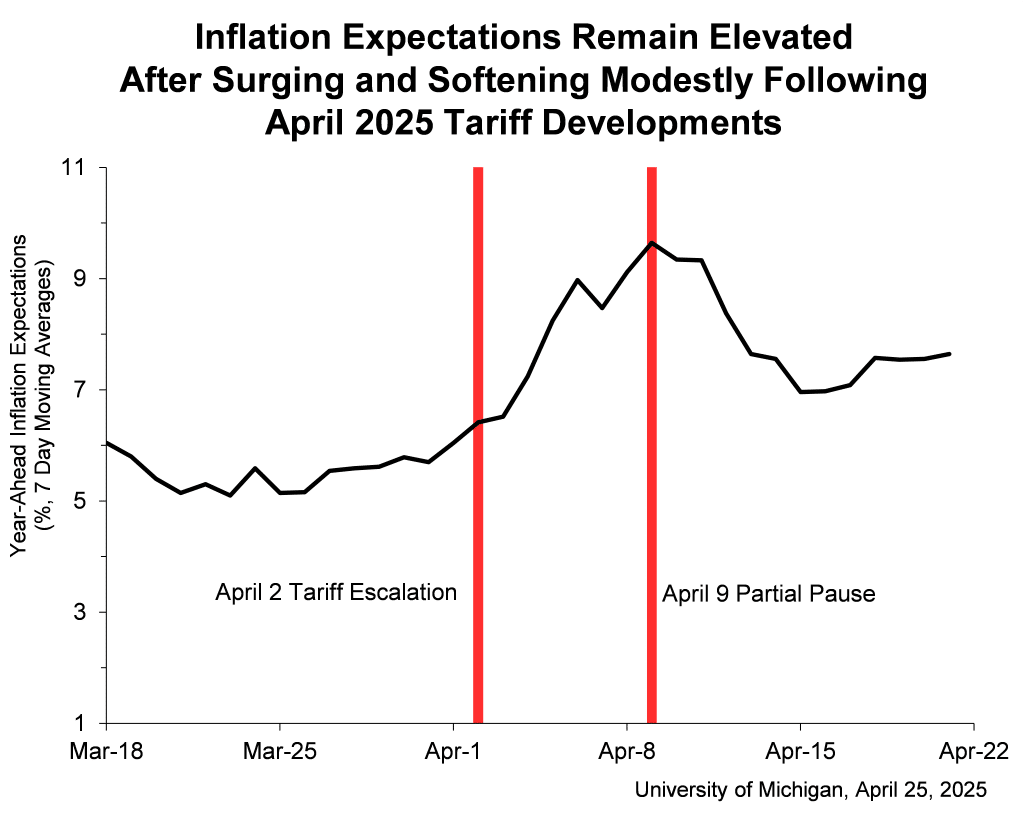
Year-ahead inflation expectations surged to 6.5% in April, the highest reading since 1981, marking four consecutive months of unusually large increases. Long-run inflation expectations also climbed from 4.1% in March to 4.4% in April.
The report highlights that inflation expectations evolved in response to trade policy announcements, with expectations ebbing after the April 9 partial pause in tariff increases but remaining substantially elevated compared to March.
The survey findings confirm that these trends are consistent across political affiliations. Despite large partisan differences in consumer sentiment levels, the report shows that all three political groups – Democrats, Republicans, and independents – have moved in parallel patterns since the presidential transition.
“The fact that all three political groups have moved in parallel shows that declines in national estimates are not being driven by disproportionate declines among Democrats alone following the election of a Republican president,” the report states.
Consumers expressed concerns about multiple aspects of the economy, particularly ongoing uncertainty around trade policy and potential inflation resurgence. Labor market expectations remained bleak, with consumers anticipating weaker personal income growth in the year ahead.
“Without reliably strong incomes, spending is unlikely to remain strong amid the numerous warning signs perceived by consumers,” Hsu noted.
The University of Michigan survey also found that political affiliation continues to influence economic views, with consumers affiliated with the party in the White House typically showing higher sentiment levels. However, independents consistently express views aligned with national averages, validating the survey’s measurement approach.
According to the report, independents consistently express views that align with national estimates, even during politically charged presidential transitions. When examining the data from 2016 through 2025, independents’ sentiment remained squarely between Democrats and Republicans during White House transitions, tracking closely with the overall index.
This positioning validates the survey’s approach, as the report explains that “the consistent alignment of national estimates with independents, a group that is less likely to be influenced by partisan extremes, shows that national trends capture meaningful changes in overall consumer views of the economy.”
Regarding inflation specifically, the April 2025 data shows that independents’ inflation expectations have risen significantly. Long-run inflation expectations in April saw “a particularly large jump among independents,” contributing to the overall increase from 4.1% in March to 4.4% in April. This pattern is consistent with previous trends where independents’ inflation expectations have “consistently been closer to the political party not in the White House” across administrations.
Since the 2025 presidential inauguration, independents’ economic sentiment has declined in parallel with both Democrats and Republicans, though they position themselves “slightly closer to the party not in the White House,” continuing a pattern observed in late 2024. This parallel movement across all three political affiliations demonstrates that current economic concerns transcend partisan perspectives.
The data also reveals that political affiliation itself is somewhat fluid. The report notes that “re-interviews in 2025 reveal that about 20% of consumers are changing their self-reported political affiliation between interviews,” suggesting that people’s political identity may shift in response to economic conditions rather than remaining fixed.
This fluidity, combined with independents’ middle-ground perspective, reinforces the survey’s conclusion that “overall partisan differences in economic perceptions and expectations may be large, but monthly trends in sentiment across time are unlikely to be distorted by differential survey completion by political affiliation, or to be merely an artifact of partisan differences in views. Instead, national trends capture meaningful changes in overall consumer views of the economy.”
Author

Related Articles

9-11 remembrances highlight another busy week of events across Kerr County
Friday brings three separate ways to mark the anniversary of the Sept. 11, 2001 attacks, alongside a midweek event tied to Kerrville’s own flood recovery.

Schreiner outlasts Austin College 33-27 in program’s first game since 1956
First-year coach Keith Allen didn’t sugarcoat his team’s first outing. Asked what went well, he said: “We scored more points than the opposing team.” Asked what didn’t: “Everything else. We’ve got to clean up a lot of stuff.”

Kerr County gas prices near record highs, far above last year’s rates
Statewide, regular gasoline is up from $2.77 a gallon a year ago — an increase of nearly 33%. Nationally, the trend looks similar. AAA’s national average stood at $4.14 a gallon this week, up from $3.19 a gallon a year ago, a jump of about 30%.
Comments (0)
There are no comments on this article.