
Ingram, Hunt lead the way in Kerr County statewide academic scores
Ingram and Hunt ISDs earned some of the strongest numbers in the county, Kerrville ISD showed signs of a rebound alongside a few slipping campuses, and Center Point ISD saw declines at two of its three campuses.
The Texas Education Agency released preliminary 2025-26 A-F accountability ratings Friday, offering the first look at how Kerr County’s public schools performed this year under the state’s academic rating system — and the results split sharply along district lines.
Ingram and Hunt ISDs earned some of the strongest numbers in the county, Kerrville ISD showed signs of a growth alongside a few slipping campuses, and Center Point ISD saw declines at two of its three campuses.
Because the ratings weren’t released until Friday, none of the districts had issued public comment as of this story’s publication. This account is based on the preliminary campus- and district-level data TEA has published so far, along with the agency’s statewide release.
The statewide picture
TEA rated 1,202 districts and 9,105 campuses this year. Statewide, 24% of both districts and campuses saw their rating increase from 2025, and 585 campuses moved from below an A up to an A. Overall, 85% of rated campuses posted “acceptable” academic performance — a C or better.
“This year’s A-F ratings illustrate the progress Texas public schools are making and acknowledge the hard work of our educators while illuminating areas of needed improvement to ensure that all students have access to a high-quality education,” Texas Education Commissioner Mike Morath said in a statement accompanying the release.
TEA also highlighted gains among high-poverty campuses: 49% of high-poverty campuses that received a rating earned an A or B in 2026, up from 47% a year earlier, while the share of F-rated campuses statewide declined.
Compared to that modest statewide upward trend, Kerr County’s results were mixed.
How the ratings work
TEA grades every district and campus A through F based on three components: Student Achievement (STAAR performance, graduation rates and college/career readiness), School Progress (year-over-year growth, including compared to schools serving similar economically disadvantaged populations), and Closing the Gaps (how well a school serves every student group). Those components are weighted and combined into a single overall score out of 100.
One note on comparisons: TEA changed its scoring standards beginning with the 2022-23 school year, so scores from before that year measure a somewhat different bar than those from the past four years.
Ingram and Hunt lead the county
Both districts posted district-level A ratings, the only two in Kerr County to do so.
Hunt ISD, a small district with a single K-8 campus serving 211 students, earned an overall A/92 — with A’s across every component: Student Achievement (93), School Progress (93) and Closing the Gaps (91). That’s part of a multi-year climb: Hunt School’s overall rating has risen from B/84 in 2023 to A/93 in 2024 and A/94 in 2025, before settling at A/92 this year — still near the top of Region 20.
It’s also worth noting Hunt’s results don’t stand entirely on their own: the district has no high school, and many of its eighth-graders continue on to Ingram ISD campuses — meaning some of the same students show up in both districts’ strong numbers.
Ingram ISD also earned a district-level A/91. Ingram Elementary held at A/91, essentially unchanged from the previous three years (90, 91, 91) — a rare streak of stability at the top. Ingram Tom Moore High School was even stronger, posting A/93 with Student Achievement at 92, continuing a run of A ratings dating back at least four years. The one soft spot was Ingram Middle School, which dropped to B/85 after an A/91 last year — still a solid score, but a step down worth watching, particularly as meets-grade-level rates have declined for two straight years and Social Studies remains a persistent weak point.
Kerrville ISD: real gains, real gaps
Kerrville ISD, the county’s largest district with 4,402 students across eight campuses, held a B/81 overall rating — up slightly from B/80 last year. Its campus-by-campus results, however, show genuine improvement in some areas alongside decline in others.
The clearest good-news story is Starkey Elementary, which climbed to C/75 this year after posting an F/58 in 2024-25 — a significant one-year recovery. The campus carries an important designation to understand: after its F rating last year, TEA identified Starkey for what the state calls “comprehensive support and improvement,” a formal intervention process that requires the district to develop and implement a targeted improvement plan. This year’s jump to a C means Starkey is now listed as a “CSI progress school,” meaning it has improved, though it has not yet exited the program. The campus remains below the B and D scores it posted in 2023 and 2024.
Tivy High School showed sustained progress, with its Student Achievement score rising from 77 to 82 to 87 to 88 over the last four years, landing at an overall B/85. Fred H. Tally Elementary stayed strong, posting a B/86 overall with an A-level Student Achievement score of 90, though that’s down from its A/92 and A/91 the two previous years.
Kerrville ISD also has concerns worth watching. Daniels Elementary slipped from B/81 last year to C/77 this year. Buried inside that otherwise moderate score is a more serious signal: Daniels earned an F on the Academic Growth sub-score — the part of the rating that measures whether individual students are improving year over year — for the second consecutive year. That F is offset in the overall calculation by a stronger Relative Performance score, which compares the campus to other schools serving similar populations of economically disadvantaged students. Nimitz Elementary also declined, from B/88 last year to B/85 this year, with Student Achievement falling from 80 to 82 over the past two years against a backdrop of stronger scores earlier. Peterson Middle School maintained a score of B/80 for the third straight year, with Social Studies scores declining from 27% to 23% meets-grade-level.
Center Point ISD: the district to watch
Center Point ISD posted the lowest district-level overall score in the county at C/79, and the campus data explains why.
Center Point Elementary earned an overall D/69 this year — the same score it posted two years ago, after recovering briefly to C/77 last year. What makes this year’s D particularly significant is how it was calculated: TEA’s rules cap a campus’s overall score at 69 when it scores below 70 on Student Achievement and below 70 in at least two other domains. Center Point Elementary hit that threshold this year, earning D scores in Student Achievement (69), Relative Performance (65), and Closing the Gaps (68) — meaning even a slightly higher score in one area wouldn’t have changed the headline number. The campus has also been identified for what TEA calls “targeted support and improvement,” a state intervention designation triggered by persistent underperformance among specific student groups. Only about 40% of its students are meeting grade-level standards on STAAR, and no subject broke 45% this year.
Center Point Middle School also declined, settling at C/78 overall, down from B/82 two years ago. Its Student Achievement score has slipped from the high 70s to 75 this year, and Social Studies — at just 21% meets-grade-level — is a notable area of concern.
The exception inside Center Point ISD is the high school. Center Point High School posted a B/89 overall — the strongest score of the three campuses by a wide margin — driven largely by a 100% graduation rate and strong college and career readiness outcomes, which pushed Student Achievement to an A/90. STAAR performance at the high school level is more modest; the overall score is being carried by those non-STAAR metrics. That leaves the district with a notable internal split: a high school posting its strongest mark in at least four years, and two feeder campuses that have been declining.
Divide ISD: steady, if small
Divide ISD, the county’s smallest district with just 41 students across one campus, posted a B/82 overall, essentially maintaining last year’s B/83. Small enrollment means year-to-year swings carry less statistical weight, but the direction is positive — meets-grade-level rose from 50% to 58% this year.
What’s next
Friday’s numbers are preliminary. Districts and campuses typically have a window to review and appeal results before TEA finalizes ratings later in the year, and it’s common for scores to shift slightly between the preliminary and final release.
The A-F accountability system was created in 2017 by the 85th Texas Legislature through House Bill 22. Full ratings, along with campus-level detail, are available at TXschools.gov.
The scores released Friday are also among the last to be measured entirely under the current testing framework. Beginning with the 2027-28 school year, Texas will replace the STAAR exam for grades 3-8 with three shorter assessments spread across the beginning, middle and end of the school year, under House Bill 8 signed by Gov. Greg Abbott in September 2025. High school end-of-course exams remain largely in place under the new law. Separately, new K-8 social studies curriculum standards adopted by the State Board of Education this summer are set to take effect in classrooms beginning with the 2026-27 school year — changes that could influence how future student cohorts perform on social studies assessments, an area where several Kerr County campuses already show measurable weakness.
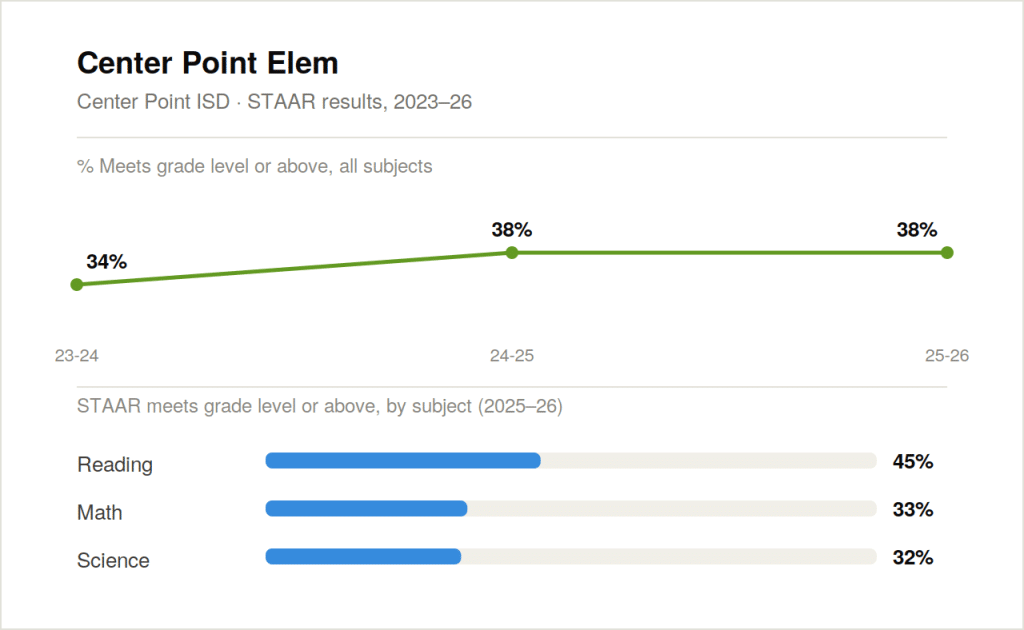
Center Point Elem — D / 69 overall (2025-26) The weakest score in the county. STAAR meets-grade-level rates have been flat in the high-30s for two years after a jump from 34% in 2023-24, and no subject broke 45% this year. Worth a direct question to the district about what’s driving the gap between this campus and Center Point’s other two schools.
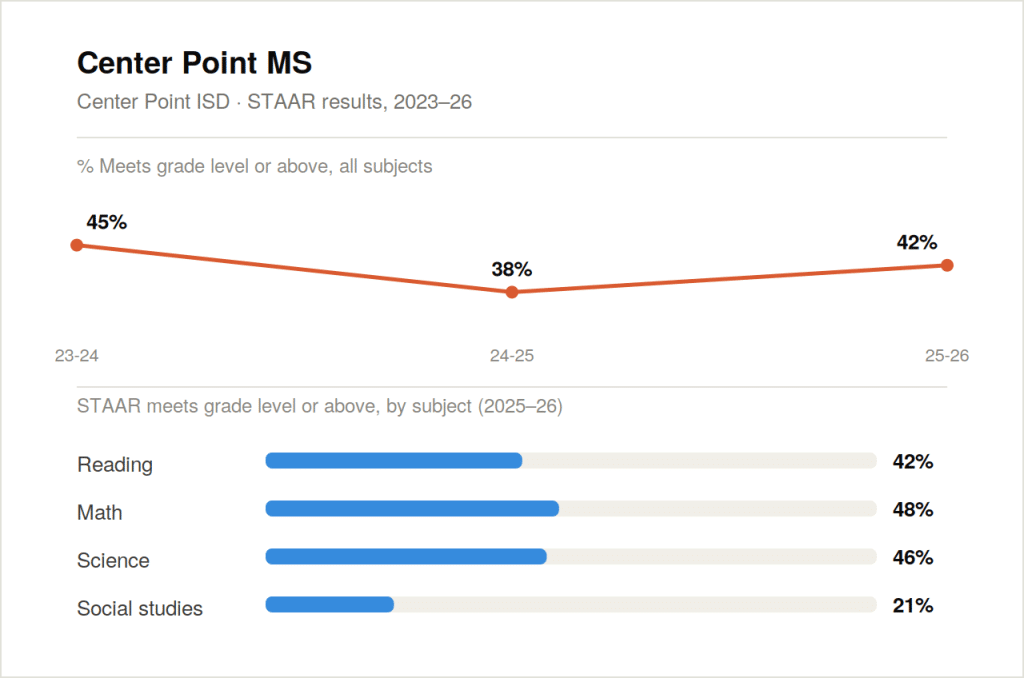
Center Point MS — C / 78 overall STAAR performance has slipped from 45% meets-grade-level in 2023-24 to 42% this year, with Social Studies particularly weak (21%). Component scores (Student Achievement 75, School Progress 79, Closing the Gaps 74) are all C-range — no single number stands out, which is itself part of the story of a campus treading water.
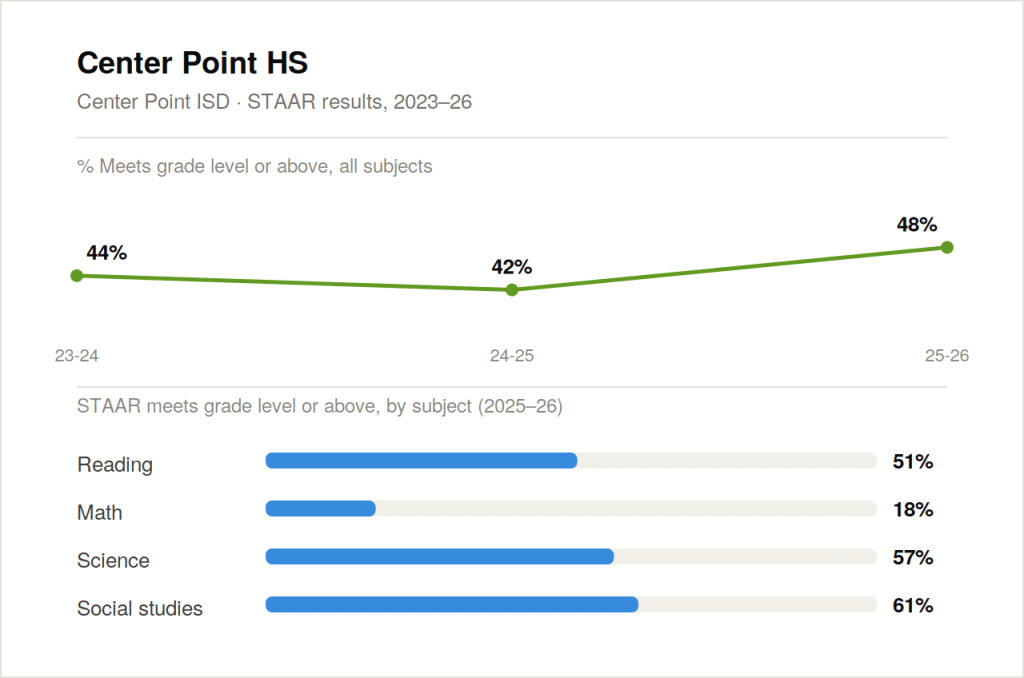
Center Point HS — B / 89 overall The strongest of Center Point ISD’s three campuses by a wide margin, and the only one trending up — meets-grade-level rose from 44% to 48% over three years, with Social Studies climbing to 61%. Math remains a soft spot at 18%.
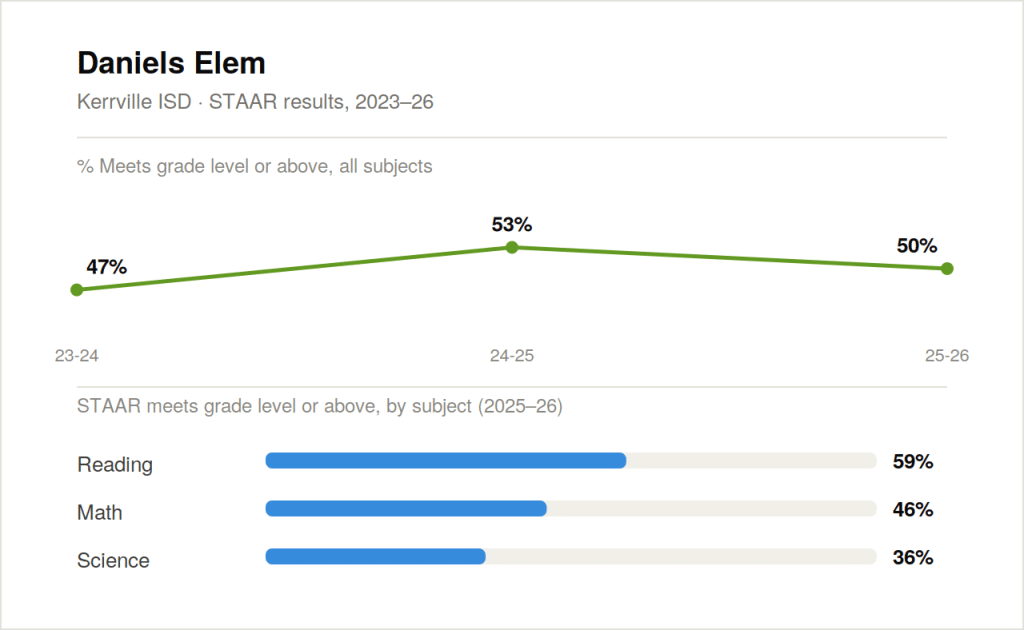
Daniels Elem (Kerrville ISD) — C / 77 overall The headline components look stable (Student Achievement 77, School Progress 80, Closing the Gaps 69), but the detailed TEA rating breakdown shows Daniels’ Academic Growth sub-score — the part of School Progress that measures individual student growth — earned an F (58) this year, offset by a strong Relative Performance score. That F doesn’t show up on the standard overview page and is worth a line in the story. STAAR meets-grade-level dipped slightly to 50% after a high of 53% last year.
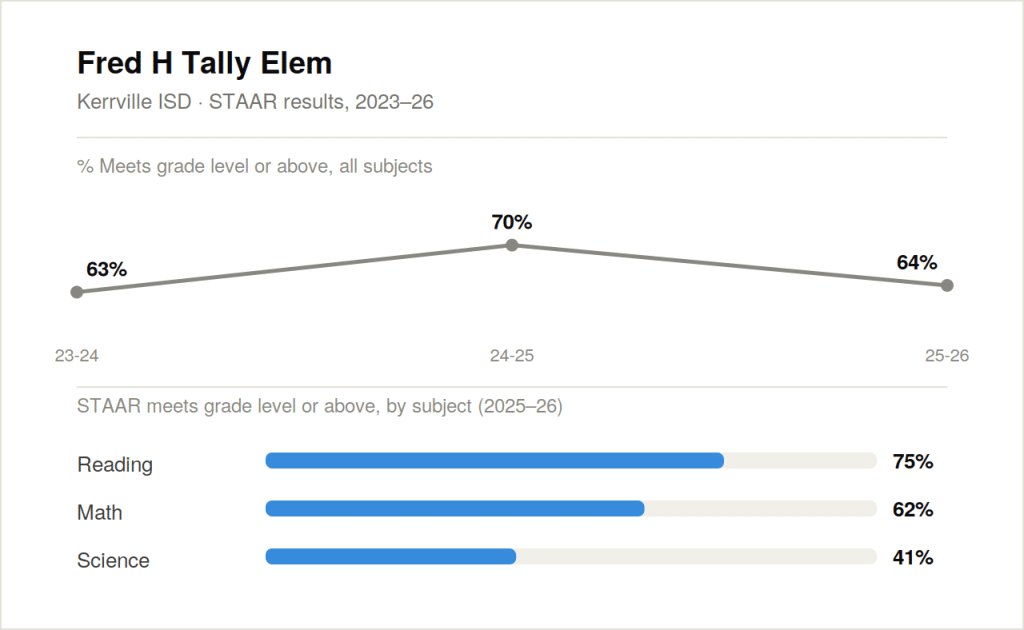
Fred H Tally Elem (Kerrville ISD) — B / 86 overall One of the county’s stronger elementary campuses. STAAR meets-grade-level peaked at 70% in 2024-25 before pulling back to 64% this year — still well above the 63% starting point three years ago. Reading (75%) is a clear strength; science (41%) lags.
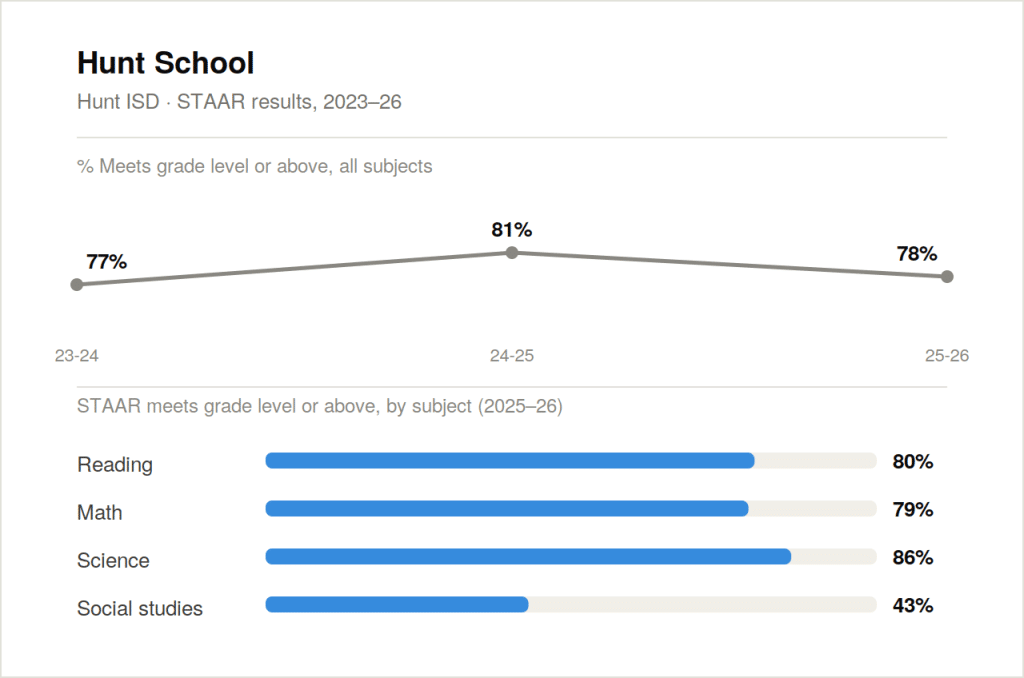
Hunt School — A / 92 overall Consistently the county’s top performer. Meets-grade-level has held in the high 70s to low 80s for three years. The one notable dip is Social Studies, which fell from 71% to 43% this year — worth a mention even inside an otherwise strong record.
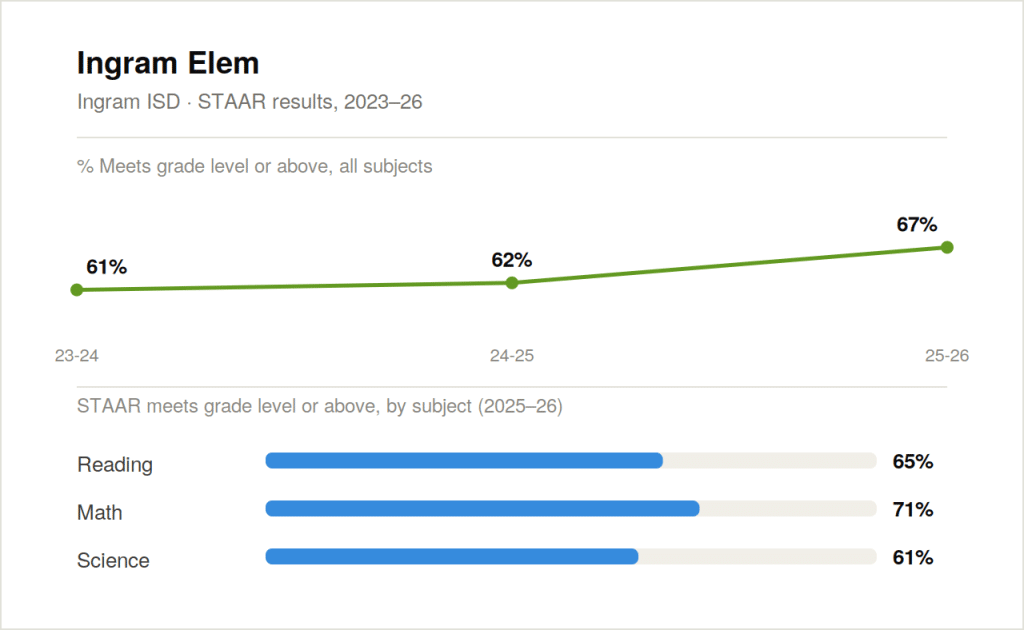
Ingram Elem — A / 91 overall The steadiest campus in the county — meets-grade-level has climbed each year (61% to 67%) with no weak subject this cycle; math led at 71%.
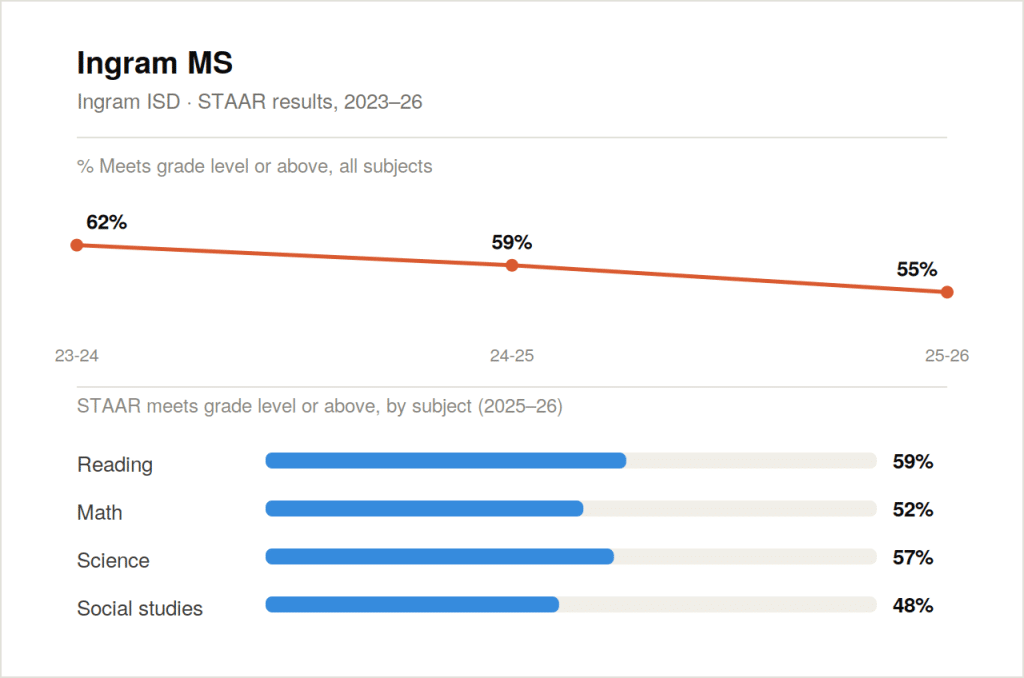
Ingram MS — B / 85 overall Meets-grade-level has declined for two straight years, from 62% to 55%, and Social Studies is a persistent soft spot (48% this year, down from 52%). Still a solidly rated campus, but the direction is worth flagging alongside Ingram Elem’s opposite trend.
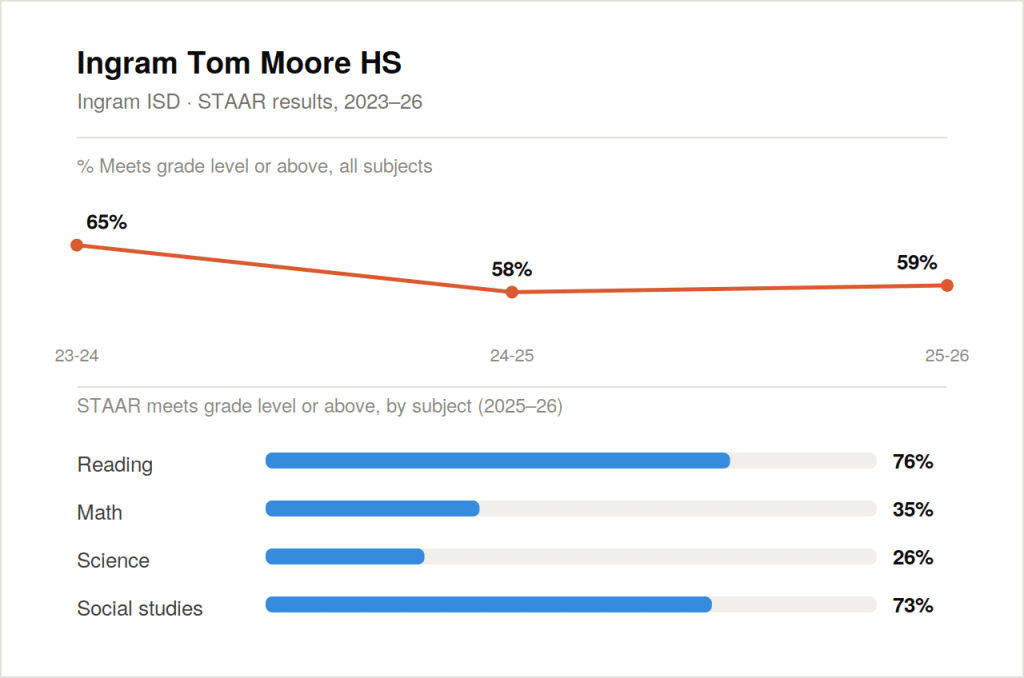
Ingram Tom Moore HS — A / 93 overall Strong on paper (A/93), but STAAR performance tells a more mixed story: meets-grade-level fell from 65% to 59% over three years, driven by math dropping from 54% to 35% and science from 54% to 26%. Reading (76%) and social studies (73%) are carrying the average.
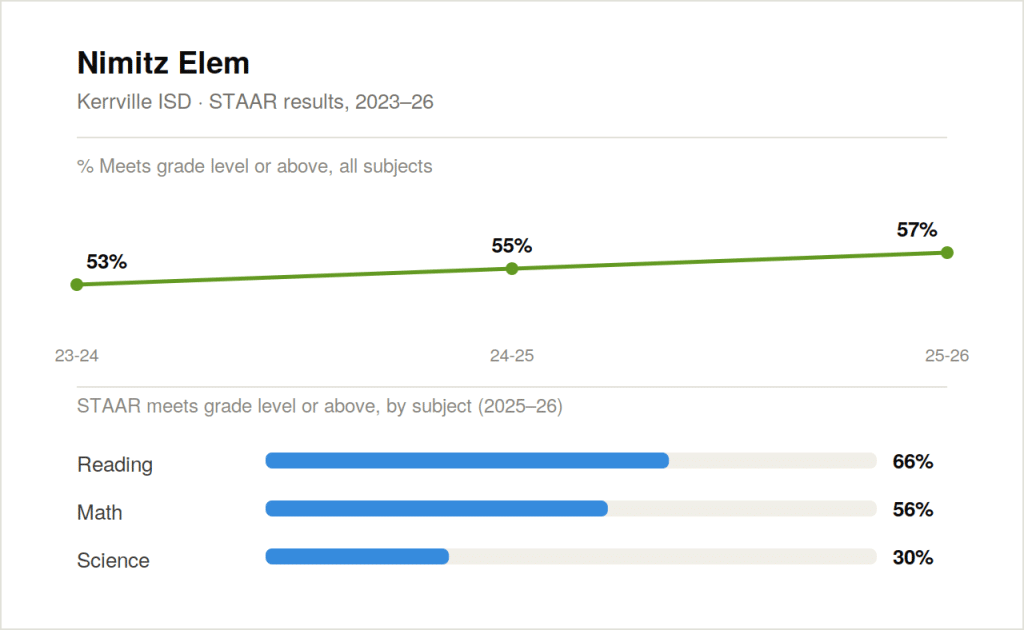
Nimitz Elem (Kerrville ISD) — B / 85 overall A genuine improvement story — meets-grade-level rose from 53% to 57% over three years, with reading up to 66%. Science (30%) is the lagging subject.
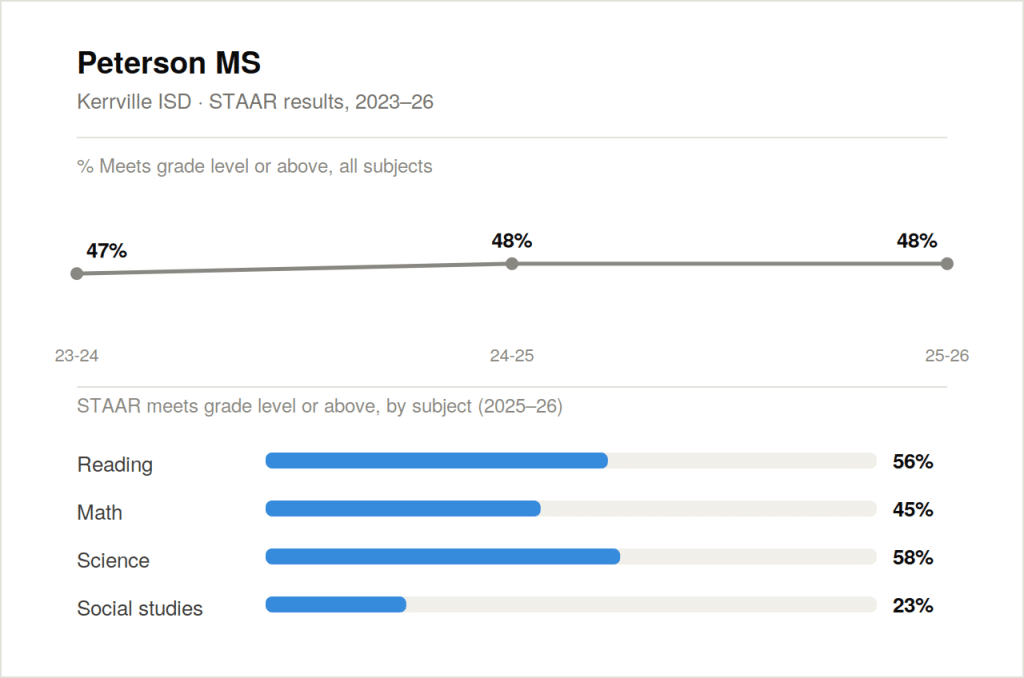
Peterson MS (Kerrville ISD) — B / 80 overall Essentially flat for three years (47%, 48%, 48% meets-grade-level). Social studies is notably weak and getting weaker (27% to 23%), a pattern worth asking the district about.
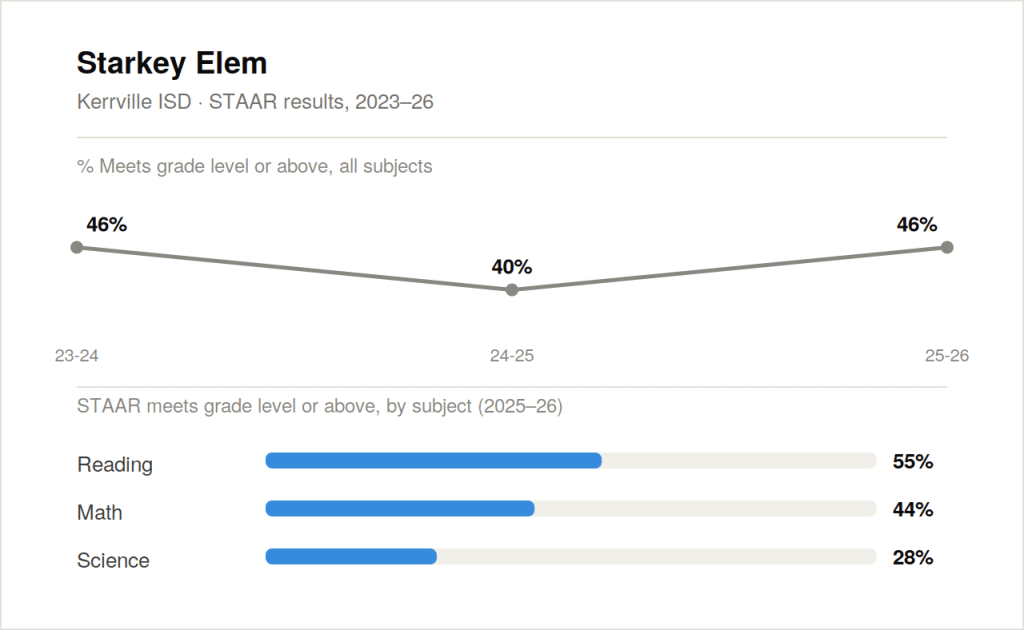
Starkey Elem (Kerrville ISD) — C / 75 overall The county’s clearest volatility story. Student Achievement scored an F (58) in 2024-25 before recovering to the low-70s this year (currently C-range at 72). STAAR meets-grade-level dropped from 46% to 40% and has since recovered to 46% — net flat over three years despite the swing in between.
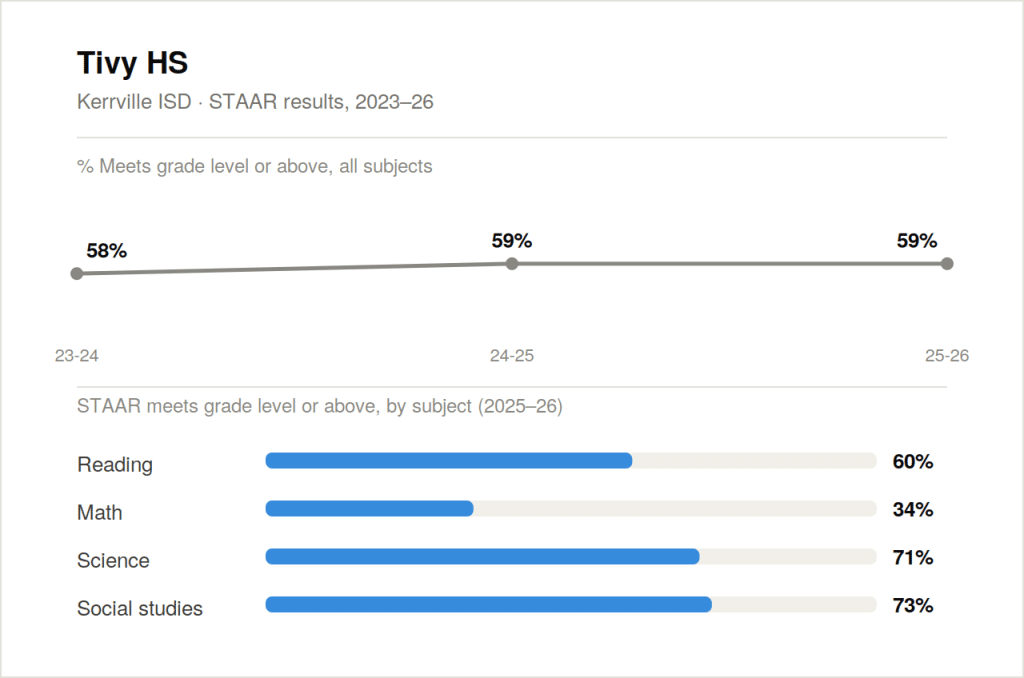
Tivy HS (Kerrville ISD) — B / 85 overall Stable and solid: meets-grade-level has held at 58-59% for three years. Math (34%) is a clear weak point against otherwise decent reading (60%), science (71%) and social studies (73%) numbers.
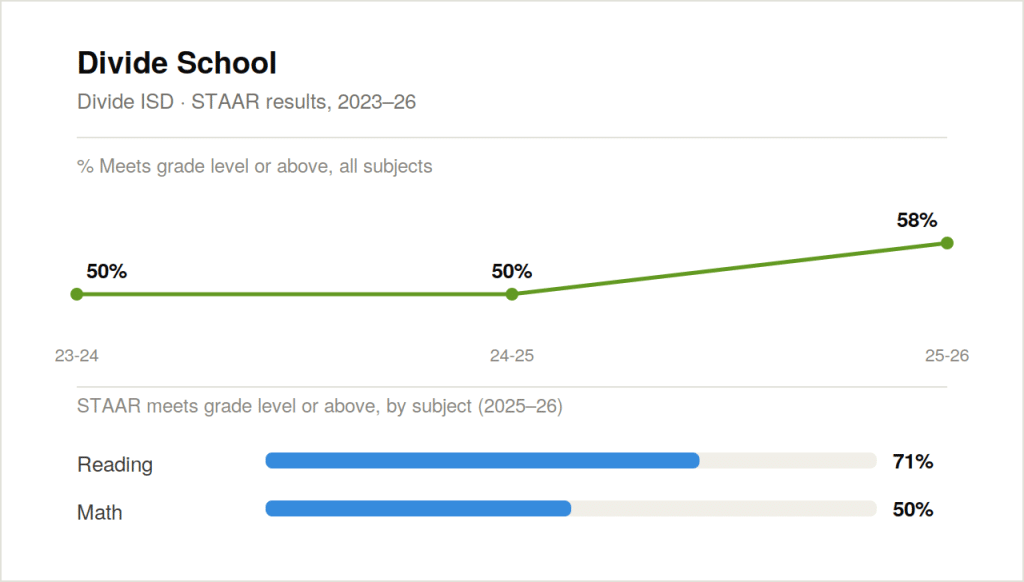
Divide School — B / 82 overall Small sample sizes (well under 20 tests some years) make year-over-year swings less meaningful here, but the direction is positive — meets-grade-level rose from 50% to 58% this year, with reading at 71%.
Author

Related Articles

The top 25 moments from Lead Live’s Fifth Annual Nonprofit Week — so far
Sixty-eight segments. 121 guests. Six broadcast days, totaling more than 30 hours. What follows are the 25 moments from The Lead Live’s Fifth Annual Nonprofit Week that we can’t stop thinking about — the revelations, the stories, and the lines that captured something true about Kerr County in the summer of 2026.

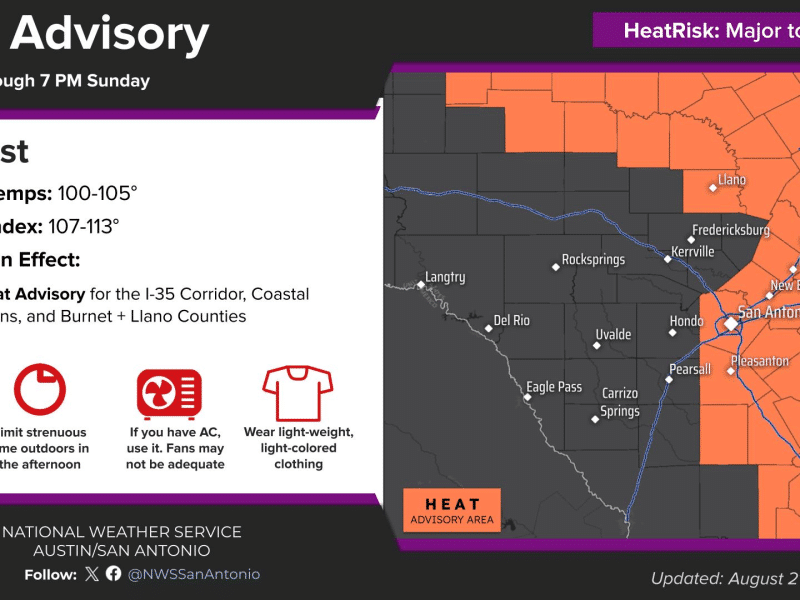
Kerr County weather: First 100-degree stretch of the year arrives this weekend
Saturday is mostly sunny and hot, with a high near 101 and a heat index as high as 104. Light and variable wind will become south-southeast at 5 to 10 mph in the afternoon. Skies turn partly cloudy Saturday night, with a low around 74 and south wind 5 to 10 mph.
Comments (0)
There are no comments on this article.