
The top 25 moments from Lead Live’s Fifth Annual Nonprofit Week — so far
Sixty-eight segments. 121 guests. Six broadcast days, totaling more than 30 hours. What follows are the 25 moments from The Lead Live’s Fifth Annual Nonprofit Week that we can’t stop thinking about — the revelations, the stories, and the lines that captured something true about Kerr County in the summer of 2026.
Sixty-eight segments. 121 guests. Six broadcast days, totaling more than 30 hours. What follows are the 25 moments from The Lead Live’s Fifth Annual Nonprofit Week that we can’t stop thinking about — the revelations, the stories, and the lines that captured something true about Kerr County in the summer of 2026.
1. Dana Edson says ‘I’ll test’ before she finishes the thought
Working a routine pre-op shift, Kerrville nurse Dana Edson asked a patient whether she had both kidneys. The patient said no — she’d donated one to her son 16 years ago, and her son needed a new one. Edson’s response came out before she thought about it: “Well, I’ll test.” That impulse triggered the largest organ swap in Texas at the time — a six-way exchange across three Houston hospitals. She found out the next day that living donors go near the top of the transplant list if they ever need an organ themselves. The Ultimate Gift of Life.
2. ‘Disasters do not change the circumstances of low-income people. They exacerbate them.’
TRLA Supervisory Attorney Brittanny Gomez described families who cannot access FEMA flood repair funds because their generational homes — owned for decades — were never formally probated. No clean title means no federal money. The legal infrastructure of poverty was there long before the water. The floods just made it impossible to ignore. Texas RioGrande Legal Aid.
3. ‘I pretty much just copy-pasted 2025’
When All Hands and Hearts asked Center Point Alliance for Progress Vice President Anna Love for the list of homes affected by the July 16, 2026, flood, she did not have to research it. She copied and pasted the 2025 list. The same families. The same homes. The same neighborhoods. That single sentence is the most efficient summary of what back-to-back floods have done to this community. Center Point Alliance for Progress.
4. Brad Freeland decided to donate a kidney on the drive home from his son’s funeral
Freeland’s 19-year-old son died accidentally and saved nine lives through organ donation. On the drive home from the funeral, Freeland made a decision: he would give a kidney to his friend Ryan Pendergraft, who had been rejected by multiple transplant hospitals. The organization Pendergraft founded in Freeland’s name now covers the financial costs — travel, lodging, lost wages — that insurance never pays for living donors. Texas Transplant Network.
5. The Zunker family scholarships are permanent
In the aftermath of the loss of the Zunker family — killed together in the deadly 2025 flood that claimed 119 lives across Kerr County — the Kerrville Public School Foundation established four permanent, named scholarships: one each for Reese, Paula Jo, Lyle, and Holland, reflecting each family member’s passions. The board chose one word to describe them: permanent. Kerrville Public School Foundation.
6. Kerr Together couldn’t legally accept a donation for over a year
The organization that has been coordinating all of Kerr County’s flood recovery since July 2025 was structured as a 501(c)(6) business league under the Kerr EDC — which legally cannot receive charitable contributions. They coordinated relief for 966 affected residents and 223 damaged homes without being able to take a check. The transition to 501(c)(3) status is now underway. Kerr Together.
7. Habitat rebuilt 30 homes — and three of them took no water in the second flood
Habitat for Humanity of Kerr County went from building two or three houses a year to repairing and rebuilding 30 flood-damaged homes. When the July 16, 2026, flood hit, three of those rebuilt and elevated homes took absolutely no water. Of the remaining 27, only 10 had any damage at all — and most of it was minor. The mitigation is working. Habitat for Humanity Kerr County.
8. Eight Lions Club members raised $140,000
The Kerrville Sunrise Lions Club has eight members. After the 2025 flood, those eight people established a 501(c)(3) foundation and raised $140,000 in direct relief for local families — getting cash into people’s hands within days when larger agencies took weeks. After the 2026 flood, with far less national attention and almost no outside donations, they have 25 families on a waiting list. Kerrville Sunrise Lions Club.
9. The funding collapse: $2.3 million versus $35,000
The Kerrville Area Chamber Foundation raised $2.3 million and distributed nearly $2.2 million in direct business grants within weeks of the 2025 flood. After the 2026 flood — same community, same number of damaged businesses — it has raised $35,000. The difference is not the damage. It is the death toll, and the national attention that follows it. Kerrville Area Chamber of Commerce Foundation.
10. The walk-in shoe store
First responders working the river channel for days had boots rotting off their feet. Manufacturers donated replacements — a completely disorganized pile of footwear. The Citizens Police Academy Alumni Association organized it into a functional shoe store, sorted by gender and size, in two hours. The organization won Texas Association of the Year for its 2025 flood response. Kerrville Citizens Police Academy Alumni Association.
11. ‘I pretty much just forgot we were an art gallery’
The Hill Country Arts Foundation was functioning as a mud-shoveling operation after the flood. Rachel Lovelace had entirely forgotten a printmaker exhibition was scheduled. Local artists Randy Thompson and Al Zirkel collected the artwork at Lift Coffee, slipped into the gallery, and hung the entire show themselves. When Lovelace walked in and saw it, she broke down crying. It was packed. Hill Country Arts Foundation.
12. David Robbins lost his license to glaucoma at 49 — and now runs the organization that saved him
Robbins described the loss of his driver’s license as losing his freedom and independence entirely. KerrKonnect provided him a lifeline. He eventually became its Executive Director. He came to The Lead Live with his guide dog Price and the most precise math of the week: every new volunteer driver removes exactly three people from a 120-person, eight-month waiting list. KerrKonnect.
13. Caitlin Jones and the white towels
Kathy Hall and Caitlin Jones were matched through Big Brothers Big Sisters when Caitlin was 10. Their first outing was a Walmart trip for white sweat towels. Over the next 14 years: shopping trips with a budget, trails, baking, reading food labels at H-E-B. Caitlin graduated Tivy, commanded the JROTC unit, became the first in her family to earn a college degree — from Texas A&M — and now works at Peterson Health. She is 24 and on the BBBS board. Big Brothers Big Sisters of the Texas Hill Country.
14. Will Scott went from rarely leaving his house to sitting on The Lead Live
Veterans Assistance Dogs of Texas placed Cole — 120 pounds — with Will Scott nearly four years ago. Cole retrieves what Will can’t bend to pick up, braces when Will’s back gives out, and climbs on top of him during nightmares until they stop. Board member Sarah Kocurek described what happens after placement: “They go from essentially hobbits inside their homes to they’re back out in the public again.” Veterans Assistance Dogs of Texas.
15. The ‘Smoke Pit’ is saving younger veterans’ lives
Gunny’s Warriors named their twice-monthly dinner gathering after the informal areas on military bases where deployed troops decompress. No agenda. Just veterans getting food together. It has grown to 25-30 people and functions as a phone tree — if someone doesn’t show up, the group checks on them. Jan and Mike Pieraccini housed 19 veteran families after the July 2026 flood. Gunny’s Warriors.
16. 32 families are home in Hunt. Eight more are in progress.
The Hunt Preservation Society’s home repair program prioritized what Lisa Field called “legacy homes” — properties that have been in the same family for 50 years or more, which typically don’t qualify for conventional federal aid programs. Those homes are Hunt’s identity. Losing them would mean losing something that can’t be replaced. Hunt Preservation Society.
17. The Take Five Club has two openings — and isolation is as harmful as smoking 15 cigarettes a day
T. Teresa Salmon described the research finding that social isolation for a dementia patient is neurologically equivalent to smoking 15 cigarettes a day. The Take Five Club — which gives people with dementia structured social time while their caregivers rest — runs Monday, Tuesday, and Thursday with a maximum of 10 participants. Brenda Thompson’s own mother-in-law attends. She always remembers which days are Take Five days. Dementia Care Advocates at the Dietert Center.
18. Our Lady of the Hills took in Notre Dame and turned one building into a Pre-K through 12th grade campus
Notre Dame Academy sustained significant flooding damage on Earl Garrett and Washington Streets. OLH opened its campus to the displaced students for the year. The result: Pre-K through 12th grade sharing one building — gym, library, classrooms reallocated. Principal Bridget Collins called it “a hopping place.” The first home football game under new stadium lights is Sept. 11. Our Lady of the Hills Regional Catholic High School.
19. Mike Blackledge’s home didn’t flood
Annie’s Helping Hands elevated Mike Blackledge’s Center Point home three feet in October 2025. When the July 16, 2026, flood hit, his home took on no water. That is a specific intervention producing a specific, documented outcome. It is the only moment in six days of broadcasting where someone said: we tried something, and here is the proof that it worked. Annie’s Helping Hands.
20. 80% of pastors receive daily mental health requests — and most churches have no system for responding
Marcus Goodyear described the H.E. Butt Foundation’s Congregational Collective, which was born from that research finding. The program trains churches to use their existing relationships and programs to serve members in mental health crisis — before those members end up in an ER or a jail cell. It is now an independent 501(c)(3) with Templeton Foundation backing. H.E. Butt Foundation.
21. $1 in school mental health saves $7 downstream
The primary savings mechanism: fewer kids going to jail. The H.E. Butt Foundation’s Safe and Supported Texas Schools program starts by training teachers on their own mental wellness before asking them to support students. The return on investment is research-backed and specific. H.E. Butt Foundation.
22. 15,500 kids. 3,000 for the first time. $1 each.
Kerrville’s municipal pool couldn’t open this summer. The Salvation Army Kerrville Kroc stepped in, partnered with four local churches, and charged $1 per visit. Three thousand of those 15,500 kids had never set foot in the building before. Some found the free dental clinic. Some found the afterschool program. Some found the social services building down the hill. All of them found a pool. The Salvation Army Kerrville Kroc.
23. Divinity Family Services uses private donations to pay for mobile home skirting — because that’s what stands between a grandparent and a child
Randy Rose grew up on the campus of the Medina Children’s Home. He co-founded Divinity Family Services in 2009 with Anna Pruitt. The state contract covers overhead. Every private dollar goes directly to families — to remove the immediate structural barriers between a willing kinship caregiver and a licensed placement. Sometimes that barrier is a flight of stairs. Sometimes it is skirting on a mobile home. Divinity Family Services.
24. The Hill Country Charity Ball has 22 grant applications — and several are from organizations that weren’t flood-damaged
The board recognized something troubling in this year’s applicant pool: nonprofits with no flood damage are quietly starving because all charitable giving in the community is flowing toward disaster relief. Organizations that depend on unrestricted donations for their operating budgets are being squeezed out by a giving environment entirely focused on recovery. Hill Country Charity Ball Association.
25. The H.E. Butt Foundation called its camps at 3 a.m. on July 16 — and every family got an on-site nurse
Marcus Goodyear woke up in the middle of the night when the Frio River started rising toward the foundation’s 1,900-acre camp property. By morning, every camp had an on-site nurse, food and water had been verified, twice-daily family emails were running, and cabin protocols were executed. The River Road closed. The camps held. The foundation had done this before — and they were ready. H.E. Butt Foundation.
Nonprofit Week is not over. The Lead Live returns Monday, Aug. 24, from 9 a.m. to 12:40 p.m. for a final morning of eight interviews — including Light on the Hill, Reach Global Crisis Relief, All Hands and Hearts, The Water Street Festival, the Schreiner Song Keepers, the Kerr Arts and Cultural Center, the Texas Hill Country Trails Alliance, and Kerr Kids. All segments air live on The Kerr County Lead’s Facebook and YouTube pages and are available on demand at kerrcountylead.com/forging-connections-nonprofit-week-on-the-lead-live/.
Author

Related Articles

League of Women Voters program to focus on working elections
The League of Women Voters of Hill Country Texas will hear about what it takes to work an election at its meeting Saturday, Oct. 10, at the Riverside Nature Center.

Flood loan deadline nears for nonprofits; 0% loans still available for local businesses
Kerr County nonprofits damaged in this summer’s flooding have until Nov. 2 to apply for low-interest federal disaster loans, while a separate program is offering 0% loans to small businesses in Kerr County and Comfort.
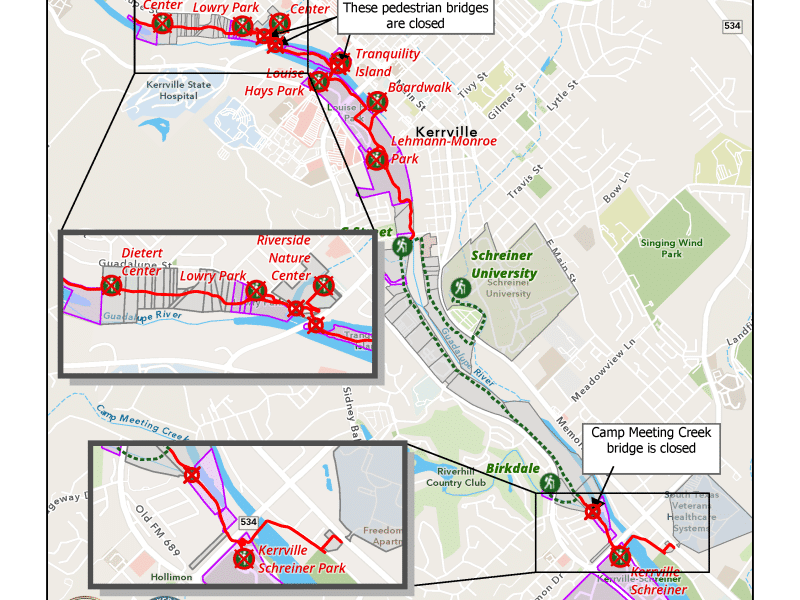
Two River Trail segments reopen Friday as flood recovery continues
The city called the reopening another step in its ongoing recovery from the July 16 flood. It credited volunteers who helped assess damage, clear debris, address hazards and restore access where conditions allow.
Comments (0)
There are no comments on this article.